


The Telco industry recently received a US$ 17 billion wake-up call. SpaceX’s massive acquisition of EchoStar’s spectrum licenses signals a definitive end to the "polite" pilot phase of New Space. It marks the beginning of an era of aggressive, proprietary expansion, where the race for Direct-to-Device (D2D) connectivity is paramount. The strategy in this new D2D race is to own 100% of the assets, including the radio spectrum itself.
As billionaires move to congest our skies, a critical question arises: Who ensures this new gold rush doesn't turn low Earth orbit into a chaotic, unusable "Wild West"?
The Threat of Spectrum Asymmetry
Integrasys CEO Alvaro Sanchez warns that a "Wild West" approach to spectrum could lead to "friendly fire," where high-power LEO satellites inadvertently jam critical defense links or degrade the service of compliant GEO operators.

INTEGRASYS CEO Alvaro Sanchez has been vocal about the dangers of this rapidly evolving reality. In a recent column, he warned that the "satellite-to-mobile revolution" is transforming the rules of the game silently. He highlights a dangerous "asymmetry" in the market: while traditional operators work within collaborative frameworks, newcomers like Starlink often operate outside of bodies like the GSMA or 3GPP, effectively bypassing the technical consensus that has guaranteed ecosystem stability for decades, now affecting Telcos around the world.
Sanchez argues that this lack of accountability creates a deep imbalance. When mega-constellations "shout louder", increasing power to reach handheld devices, without subjecting themselves to the same rigorous standardization as terrestrial networks, they risk altering the competitive and spectral equilibrium, effectively creating a monopoly.
Sanchez' current focus is on growing INTEGRASYS; developing new products, forging alliances with other defense and commercial organizations if appropriate, and partnering with Ministries of Defense (MoDs) and Departments of Defense (DoDs).
The Risk of "Friendly Fire"
As Sanchez noted during the CABSAT and IBC conferences, the push for D2D connectivity increases the risk of violating foundational International Telecommunicarions Union (ITU) Articles 21 and 22, which govern power flux density limits, and disrupting current satellite providers, a situation that national regulatory bodies must urgently address.
If unchecked, this "Wild West" approach could lead to "friendly fire," where high-power LEO satellites inadvertently jam critical defense links or degrade the service of compliant GEO operators. Sanchez has emphasized that we cannot rely on "good faith" declarations from operators; nations need a way to strictly enforce these limits in real-time.
Enter LEOREG: The Great Equalizer
In an environment defined by multi-billion dollar acquisitions and exponential fleet growth, manual regulation is obsolete. To survive, the industry needs an equalizer. This is why INTEGRASYS developed LEOREG for national regulators.
INTEGRASYS LEOREG is a user-friendly, web-based system designed to empower regulators to monitor and ensure Non-Geostationary Satellite Orbit (NGSO) constellation compliance with International Telecommunication Union (ITU) EPFD (Equivalent Power Flux Density) regulations after launch. It provides comprehensive real-time EPFD verification, improves spectrum efficiency, and minimizes interference.
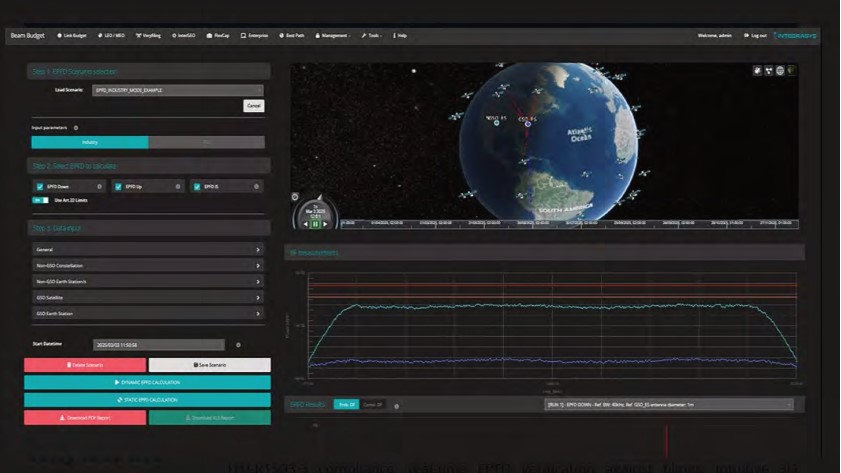
Designed to be the definitive tool for mastering the spectrum, LEOREG addresses these challenges through automation. It provides the "Compliance
Simplified, Regulation Automated" capability that Sanchez advocates for.
- Automated ITU Compliance: It replaces static spreadsheets with dynamic analysis, verifying that constellations meet EPFD limits (Articles 21 & 22) before and during operation.
- Leveling the Playing Field: It counters the "asymmetry" Sanchez warns against, giving smaller nations and operators the power to monitor and regulate massive foreign constellations effectively, ensuring national sovereignty over their spectrum and their country, as they will soon compete with their Telcos.
Securing the Future of the Spectrum
The era of aggressive expansion is undeniable. However, the fundamental physics of RF interference have not changed. If the industry wants to realize the promise of the NTN revolution—connecting any device, anywhere, at any time—it cannot rely on a single flavour, creating a monopoly.
As Alvaro Sanchez states, "we need strict, automated regulation to compete in this Telco aerospace race. With LEOREG, INTEGRASYS is providing the essential infrastructure for this new era, ensuring that while the space race accelerates, it remains compliant, manageable, and secure."
For more information on Integrasys' LEOREG go to: https://www.integrasys-space.com/leoreg-epfd-regulatory-monitoring-system
Related Articles:
 |
Interview with Alvaro Sanchez, CEO of Integrasys at the Global Milsatcom 2025 At the Global Milsatcom 2025 Conference and Exhibition in London, Satellite Markets and Research Editor-in-Chief Virgil Labrador spoke with Alvaro Sanchez, CEO of Integrasys. Click here to view the video. |
KAI Networks and INTEGRASYS Achieve World’s First NGSO Regulatory and Monitoring System Deployment
INTEGRASYS CleanRF Receives Better Satellite World Award for Protecting Critical Communications
INTEGRASYS Joins Forces with IRON Cluster to Strengthen Defense Innovation in Ukraine
INTEGRASYS Opens a New Technological Center of Excellence in France
Integrasys S.A. Company Profile