



by Blaine Curcio
It’s been a wild year in China’s satellite communications (satcom) market. The country has seen rapid growth in the number of comms satellites launched, a host of regulatory developments in the Direct-to-Device (D2D) and Non-Terrestrial Network (NTN) space, and jockeying for position among two major Non-Geostationary Orbit (NGSO) projects. The three main themes of 2025 have been the ascendance of China SatNet, question marks surrounding SpaceSail, and Geostationary Orbit (GEO) being used for all sorts of creative things. For a whole lot more information on China’s NGSO constellations, get in touch about the China NGSO Constellations Report, published by Orbital Gateway Consulting in December 2025.
The Numbers in 2025: Record Launches Driven by Constellations
2025 saw China launch an all-time high number of comms satellites at 215, exceeding the number launched in 2024 (105), as well as the total over the past six years (207 combined in 2019-2024).
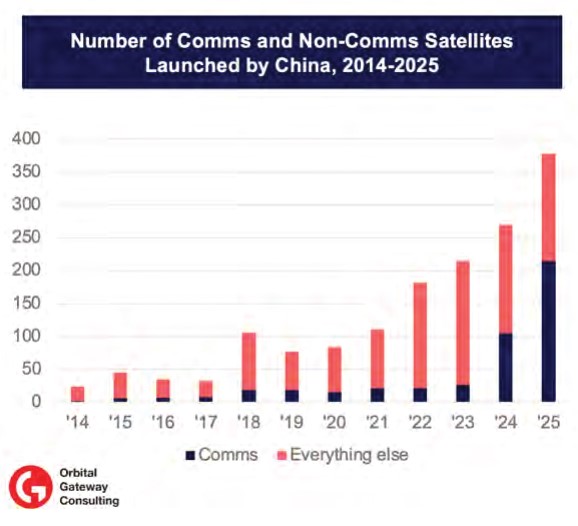 |
192 of the 215 comms satellites were launched for SatNet and Thousand Sails, China’s two large NGSO comms constellations, with the remainder being Comms Technology Test (TJS) satellites, IoT satellites from Guodian Gaoke, a couple of Tiantongs, and a few from China Satcom.
The record number of comms satellites put into orbit was enabled by two main factors:
- Ramping up of several constellation-oriented rockets, namely the Long March-6A and Long March-8A, which throughout 14 combined launches in 2025 sent 133 SatNet and Thousand Sails satellites into orbit.
- Awakening of China SatNet, a state-backed constellation that had largely failed to pick up momentum in its first ~3.5 years of existence
This marks a sharp change compared to 2024, when China’s other major constellation, Thousand Sails (aka G60) took the industry by storm, raising ~US$1B in January 2024 and launching batches of 18 satellites in August, October, and December (plus another 18 each in January and March 2025). 2025 saw only one other Thousand Sails launch after March, compared to a whopping 16 launches for China SatNet.
China SatNet’s Big Year in 2025
China SatNet was the big story in the Chinese satcom market in 2025. Established in April 2021 as an State-owned Enterprise (SOE) directly owned by the Central Government, SatNet launched only 16 satellites up to November 2024, all of which were test satellites.
In November 2024, the company launched its first batch of (10) satellites to great fanfare, and in 2025 the company really started to get moving, with 16 batch launches of 126 satellites during the year, including a strong finish of 4 launches in December. This rapid acceleration seems to have come about due to a change in company leadership.
China SatNet’s “first generation” of executives led the company from its founding in April 2021 until early 2025, and all came from state-owned aerospace and defense companies. With an average age in their early 60s, this team appeared to be risk-averse. Coming from aerospace and defense, they were likely unfamiliar with the idea of investing massive CAPEX into infrastructure without iron-clad customer agreements. If you’re the leading state-owned launch or military electronics company in China, you surely have CAPEX, but you can also be sure that eventually, you will be given contracts that will justify that CAPEX.
But building out a NGSO comms constellation is a much more uncertain proposition that more closely resembles a telco business model than a monopolist launcher one. As a result, SatNet’s first generation of leaders seemed to suffer from analysis paralysis for the first several years of the project, exhibit A being the above-mentioned 16 satellites launched between April 2021 and November 2024.
And so, in early 2025, the State-Owned Assets Supervision and Administration Commission (SASAC, the owner of SatNet) installed a new leadership team. And lo and behold, the new leadership came largely from 1) the telco world, and 2) the state-owned enterprise administration world. In February 2025, former President and COO of China Telecom Liang Baojun was appointed General Manager of SatNet, and in June 2025 a new Chairman Gou Ping, a former SASAC administrator, was brought in.
This new leadership has taken a much more proactive approach towards launching satellites, with one Chinese space industry analyst noting that the new team “changed their previous “caution” and put “maintaining frequency and occupying orbit at the forefront of their focus”, and almost immediately, the launches began coming fast and furious, with SatNet launching in April, June, and July before launching 5 batches in August.
The rapid launch cadence by SatNet in 2025 is made even more impressive by the apparent size and complexity of their satellites. While SatNet is very cryptic about things such as satellite mass, we can make estimates based on the maximum payload mass of the rockets they are using, and the number of satellites per rocket, which yield an estimated mass per satellite of around 1 ton. At the same time, certain SatNet suppliers are less tight-lipped than the company itself, so we know that most if not all SatNet satellites launched in late 2024 and 2025 are equipped with laser communications payloads, sourced from several different suppliers.
In short, over the course of 2025, SatNet has launched 126 batch satellites (plus a handful of test satellites), which has been a major boost to the constellation. All these launches have had a knock-on effect, however: they’ve used up all the constellation-oriented rockets in China, which has caused the country’s other NGSO constellation project, Thousand Sails, to be stranded upstream without a paddle (or a rocket).
Struggling to Set Sail, but Favorable Gusts Starting to Appear?
While 2025 has been smooth sailing for SatNet, its NGSO constellation rival, Thousand Sails, has been struggling. 2024 was a big year for Thousand Sails and constellation operator SpaceSail, with several batch launches, but as the year closed out, cracks were starting to appear in the façade. Orbital parameters for the first batches of satellites looked shaky: around 15 of their first 54 satellites were not ascending to their target orbit properly due to thruster issues.
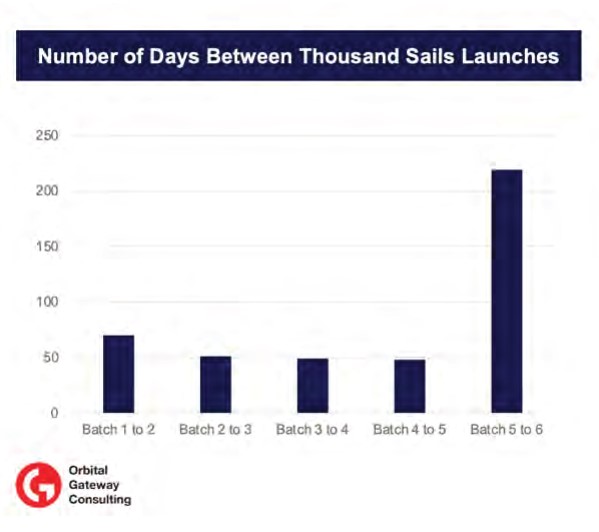 After a successful first quarter of 2025 that included launching 36 more satellites, SpaceSail has started to sputter, with time between launches rocketing up after their 5th launch. This has come largely from lack of rockets, evidenced by SpaceSail having issued several tenders during 2025 for launch services, only to cancel the tenders after they did not receive enough bids.
At the same time, SpaceSail has struggled all year with fundraising. The company raised around US$1 Billion in early 2024, putting that money to good use with a lot of launches. In late 2024, Chinese media began reporting an ongoing top-up funding round, but the big press release never came. In late 2025, an unusual press release from the Shanghai Media Group (a state-owned media company) revealed that SpaceSail was in the process of a ¥5-6 Billion funding round (US$715-850 Million), but that the funding round had not yet been completed. If SpaceSail had been getting strong interest from investors, probably such a press release would not have been necessary.
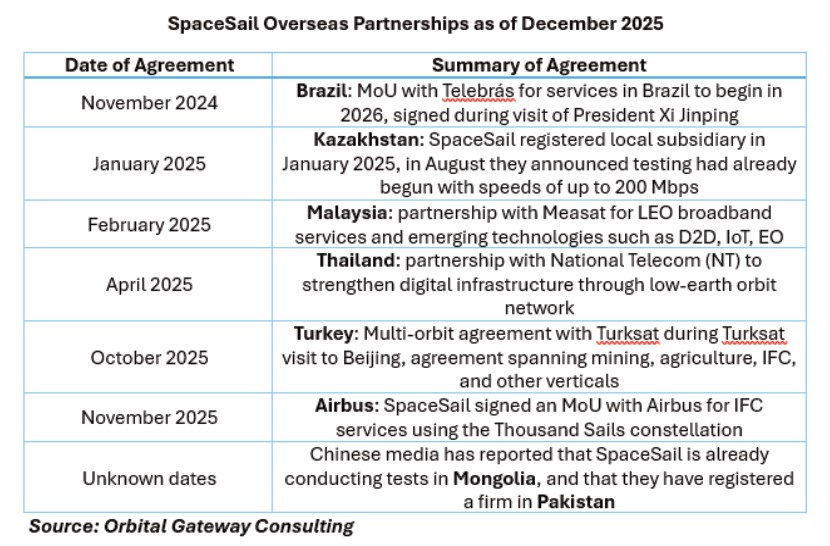
Despite these operational challenges, SpaceSail did make some meaningful commercial progress in 2025. As of the end of the year, SpaceSail has international presence in at least 7 countries, plus a very intriguing MoU with Airbus to integrate Thousand Sails with Airbus’s HBCPlus IFC offering, likely in Mainland China.
In short, SpaceSail has had a 2025 full of ups and downs. The rise of SatNet as a competitor has complicated the launch situation, while also probably causing some investors to pause before writing checks to a constellation that lacks the full state backing of SatNet. At the same time, SpaceSail has continued its march overseas, cementing its reputation as the “international Chinese NGSO comms constellation” compared to SatNet’s more domestic focus. The launch in October 2025 was a good sign, and in the very last week of the year, SpaceSail got a Christmas present of sorts when its funding round that never ends finally closed, albeit for an unspecified amount and without a press release attached to it.
Let’s Not Forget GEO
China’s GEO market is beginning to diversify beyond the state-owned China Satcom. 2025 saw several GEO relay projects gain momentum, with relay being seen as a way to get around the challenges faced by Chinese companies in setting up overseas ground stations. Cangyu Space began construction of their first GEO relay satellite, contracting with CGWIC in a deal that gives them a certain level of legitimacy (typically CGWIC does not sign contracts with fly-by-night operations).
AstralNine hired a new management team amidst a revamp, while Interstellar Data Chain and the amusingly-named “Shifang Starlink” are earlier-stage. All 4 of these companies are aiming at similar markets: connecting satellites in LEO or MEO to the ground via GEO relay satellites.
"...watch out: we may see a Chinese NGSO constellation coming to a market near you sooner rather than later..."
In the more traditional GEO comms space, ChinaSat launched 3 fairly vanilla satellites in ChinaSat-10R (replacement for ChinaSat-10), ChinaSat-3B, and ChinaSat-9C, while ramping up for the launch of the ChinaSat-27 HTS in 2026. Overall, however, China Satcom is likely in an uncertain spot: they have no stake in China’s LEO ambitions that are going to disrupt their market, and as an SOE, their toolbox to do innovative, risky things like buying small GEOs is limited. Time will tell, but without a VHTS (or several) in the medium-term, China Satcom may find themselves becoming less and less relevant into the late 2020s and 2030s.
Looking Forward to 2026
The coming year is likely to see more NGSO comms satellites launched from China, particularly if the country’s launch bottleneck starts to ease. The year will be make-or-break for SpaceSail, with the company’s credibility among its various foreign partners likely starting to wane as the launch pad remains silent. As SatNet’s on-orbit infrastructure continues to mature, 2026 will be a year of finding more commercial partners to actually use their constellation. And for the rest of the world, watch out: we may see a Chinese NGSO constellation coming to a market near you sooner rather than later.
----------------------- Blaine Curcio is the Founder of Orbital Gateway Consulting. He’s an expert on the commercial space and satellite industries with a focus on the Asia-Pacific region. He can be reached at: blaine@orbitalgatewayconsulting.com