



In the last two years, much has been made within the satellite industry of transponder shortages and higher capacity pricing impacting the Sub-Saharan African market. Evidence from NSR’s Global Assessment of Satellite Demand, 5th Edition study details the current capacity issues facing this regional market, and numerous operators have already responded. Some additional capacity on existing satellites has been relocated to the Sub-Saharan Africa market, and a number of recently launched satellites have already increased supply with more to come in the next several years.
In the last two years, much has been made within the satellite industry of transponder shortages and higher capacity pricing impacting the Sub-Saharan African market. Evidence from NSR’s Global Assessment of Satellite Demand, 5th Edition study details the current capacity issues facing this regional market, and numerous operators have already responded. Some additional capacity on existing satellites has been relocated to the Sub-Saharan Africa market, and a number of recently launched satellites have already increased supply with more to come in the next several years.
It has even been argued that the recent high demand coming from the sub-continent has led satellite operators to over-invest in new capacity for the region following the classic over/undersupply cycle that is so common within our industry. To make matters worse, others are contending that the potential oversupply situation may be compounded by the global economic downturn that could slow, at least temporarily, transponder demand growth in Africa.
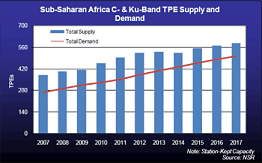 NSR is indeed focused on this satellite supply imbalance in Sub-Saharan Africa, but would argue that a closer look at the details of the situation is in order. As can be seen from the below chart for station-kept supply and demand, NSR projected in its GASD 5th Edition study that demand for commercial C- and Ku-band satellite capacity will almost double between 2007 and 2017. Leading the drive will be substantial transponder leasing gains coming from the video distribution and DTH markets in the region. African television households continue to have relatively limited programming choices, especially for locally produced content, and the region is aching for low cost DTH services. Not every venture will succeed, as illustrated by the untimely demise of GTV in early 2009, yet NSR is confident that over the long term the various video and DTH services will come to account for 60% to 80% of total transponder demand in the region, just as is found elsewhere in the world.
Traditional telephony & carrier services, as well as international trunking for ISPs in Sub-Saharan Africa, will continue to come under pressure from new undersea cables arriving in the continent, expanding terrestrial fiber routes as well as the possible emergence of competitors like O3B. However, NSR anticipates applications like cellular and broadband wireless access network backhaul as remaining solidly in the satellite camp, and these markets should outperform in the region making up for any losses from telephony and trunking. Further, NSR is seeing evidence of substantial expansion of broadband VSAT networking services in the region. While this last market segment is most susceptible to the high capacity pricing in the region and global economic conditions, it is NSR’s opinion that the overwhelming demand for connectivity will continue to lead to growth here over the long-term.
NSR is of course not alone in seeing the capacity demand trends in Sub-Saharan Africa and is aware of at least nine satellite operators that have recently or are in the progress of substantially expanding C- and Ku-band transponder supply in the region in the coming three to four years. In the GASD 5th Edition study, NSR projected new supply to be added to the region between 2008 and 2012 from at least eighteen satellites that have a primary or secondary coverage over Sub-Saharan Africa. Better than 200 additional C- and Ku-band 36 MHz transponder equivalents of new supply could be added to the region in the coming ten years (barring satellite launch and in-orbit anomalies), and this assessment was made prior to the announcement of several further satellite development projects such as New Dawn from Intelsat and Convergence Partners or the recent Middle Eastern effort, SmartSat, that could have significant coverage over Sub-Saharan Africa. Even Nigcomsat is talking of eventually expanding its fleet to three satellites including the replacement of Nigcomsat-1.
Even excluding these most recent developments, it is NSR’s view that the current efforts to increase supply in Sub-Saharan Africa will inevitably lead to a decline in fill rates in the short-term. However, it is at this point that a careful assessment must be undertaken of what ÿdeclining fill rates truly means. First, NSR includes all on-orbit and functioning commercial C- and Ku-band capacity when it publishes its estimates of fill rates for a region. When capacity that satellite operators classify as non-commercialized is excluded, NSR generally assumes that its published fill rates would increase by 5-10%, as illustrated in the below chart giving a projection of the effective fill rate (i.e. without non-commercialized capacity) for the station-kept Sub-Saharan African market from the GASD 5th Edition study. Since this is a regional estimate, it is of course understood that some satellites will have higher fill rates than others. Plus new satellites, especially those not replacing an older satellite, tend to have relatively low fill rates in the first years of their lives, which brings down the regional average. It can be seen that effective fill rates for the region in 2009 will be well into the 80% range, which is quite high by industry standards.
NSR does have to ask the question if the combination of recent launch announcements noted above, combined with the weak economic conditions, may indeed push down future fill rates. As illustrated by the above chart, NSR would not at all be surprised to see regional average fill rates in Sub-Saharan Africa fall 5% to 10% below the effective fill rate range in the 2012 to 2017 period should all the planned satellites be successfully launched and if demand growth is slowed by weak economic conditions.
Yet, does this really spell trouble for the region? Will the industry return to the situation from the early part of this decade such as in Asia or Latin America where capacity pricing plummeted and satellite operators struggled due to oversupply? NSR feels the situation in reality will be more complex, and Sub-Saharan Africa could come to somewhat resemble the situation currently found in Asia. In such a case, there will most likely be satellite operators serving Sub-Saharan Africa that have satellites in prime orbital locations, and they will be able to command premium pricing for that capacity. These stronger players will resist as much as possible the downward pressure on pricing if for no other reason than pure self interest. Conversely, there will likely be a few satellite operators or specific satellites that are viewed as "non-premium", and here one could potentially see a return to low-cost or even below-cost capacity pricing as efforts are made to fill up these satellites regardless of actual return on the investment. NSR would not at all be surprised to see satellite operators in a few years time leveling complaints at unnamed competitors offering unsustainable low pricing in Sub-Saharan Africa just as has so often been heard in the Asian market in the past.
The challenge of course in assessing what will occur in Sub-Saharan Africa is that it is subject to so many unknowns. No one knows how bad the economic crisis will become in the coming months. No one knows if there will be any satellite launch or on-orbit failures and when they will occur. Just as was the case for Sub-Saharan Africa over the last two years, so it will be the future where the loss of a single satellite critical for the region could spell havoc for the market, while the loss of a non-key satellite is almost a non-event from a supply-demand perspective. Generally speaking, NSR is very positive about the long-term prospects for Sub-Saharan Africa and believes that over a several year period, demand growth will be sufficient to absorb the new supply expected for the region. However, this does not mean that there won’t be a few quarters in the coming years where a confluence of closely spaced launches could create a short-term spike in supply. Or, as noted above, an unfortunate failure could have the opposite impact. If anything, the region offers just as much potential for success as failure, and Sub-Saharan Africa will certainly be one of the most dynamic markets to watch in the coming years.
Information for this article was extractedfrom the NSR report entitled: Global Assessment of Satellite Demand, 5th Edition