



Many countries around the world have a requirement for owning their own satellite system to apply Earth Observation (EO) to solve problems, meet new missions and reach goals - both inside and outside their territory. But not every one of them can or has the desire or political will to do it. There are however a rising number of developing countries that have projects underway such as Vietnam, Taiwan, Chile, Dubai, Algeria, and more recently in Malaysia, which puts them solidly on the EO map.
One of the biggest drivers of the market today is countries such as these where an increase in space budget and commitments to fund new projects are on an upward slope and will expand the EO market to new areas.
The encouraging successes recorded (for example) by NigeriaSat-1, which has gone beyond its 5-year design lifetime, prompted the National Space Research and Development Agency (NASRDA) there to sign a contract with EADS Astrium’s Surrey Satellite Technology Limited (SSTL) for the follow-on satellite, Nigersat-2, due for launch in 2010. Nigersat-1 was orbited in September 2003 and continues to provide data to both Nigerian and foreign users. The venture also included training at SSTL for Nigerians to learn about spacecraft manufacturing, testing and integration, a key aspect of any technology transfer and capacity build-up for developing economies with space ambitions. The Nigerian government has since recognized that through space technologies, they gain more social, political and economic freedom and as such, have given top priority to the sector.
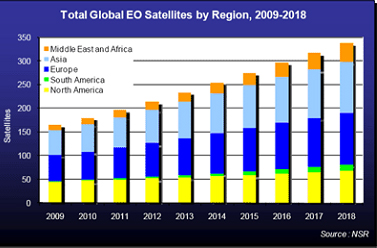 This echoes the findings of NSR’s recent report Global Satellite-Based Earth Observation in which it was has highlighted that for the past few decades, many countries in the region were left behind in the race to get EO capabilities on the ground and in space. This trend is about to change, however, as more budgets are allocated to build spacecraft and associated data processing facilities.
A pack of leaders has emerged among developing economies such as Turkey, Nigeria, China and Algeria who were associated with the seminal Disaster Monitoring Constellation (DMC) program, led by the U.K.’s SSTL. More recently, Egypt has raised its stake by launching in 2007 its own Egyptsat-1 and this year, the launch of Sumbandila by South Africa extended the club of nations in Africa that own operational EO spacecraft in-orbit.
Designed by SSTL, each of the DMC is independently-owned and controlled by each nation, but the satellites are equally spaced and operated by a private company, DMCii, to provide daily images.
This is one side of the changing picture of the EO industry, which is transforming itself as a vast majority of countries have realized the strategic importance of satellite data for economics, social and security needs and are taking the necessary steps to acquire the appropriate infrastructure in space or on the ground. The number of countries with EO satellites has only increased over the years, along with the higher spatial resolution and length of missions.
There is a partnership however that may further change the speed with which nations will be able to acquire a spacecraft of their own and develop native capabilities in data markets. This arrangement is between Algeria, Nigeria, Kenya and South Africa, which plan to cooperate in the creation of the African Resources Management (ARM) Satellite system. This system pushes further the agenda to have more capacity and sensors in-orbit within these developing countries. The system could be built in South Africa and is based on fulfilling the needs for resource management applications and high-resolution data over Africa.
As some of its proponents have said: Building the capacity of participating nations is the key to the long term success of the ARM system.
In the African region, very few local EO satellite operators exist, and the production is often ‘outsourced’ to European manufacturers. But with native capabilities such as in the University of Stellenbosch and its spin-off, SunSpace, the ARM plans could also include an African manufacturer for the space segment.
These African countries have worked together now for over six years to combine their knowledge and assets to build a constellation of satellites with wide-area coverage, high resolution and multi-spectral capabilities. If the ARM launches the way it is planned today, it will be a big step toward a global trend in the EO industry that has many developing countries wanting or actively becoming part of all facets of the this growing industry.
As the market is going through a remarkable growth phase, both in terms of breadth of players and depth of reach, and changing dramatically from being completely government-controlled to a mix between government and private ownership, the future looks bright for the countries that are building new partnerships to gain greater access to space.
Information for this article was extractedfrom the NSR report entitled: Global Satellite-Based Earth Observation