



In the recently released Mobile Satellite Services 5th Edition report, NSR noted that fears of the bottom line falling out for all MSS operators due to the economic crisis were overestimated; however, caution was still the best attitude one could take for the short-term. NSR also noted that the first quarter 2009 numbers had already given indications that operators are not protected from hardship and slowdowns.
As we just passed the mid-point of the calendar year, MSS operators now have a better idea if annual results will look as expected or worsen. It is also a time to reflect on a serious realignment of the business for the next six months to meet annual targets, which is especially important early in the third quarter when most customers are back from holidays and start using their equipment again on a more regular basis.
For some, it is a much bumpier ride with some markets showing signs of exhaustion coupled to the world economic slowdown affecting oil and gas exploration, transportation, shipping, and last (but not least) financing.
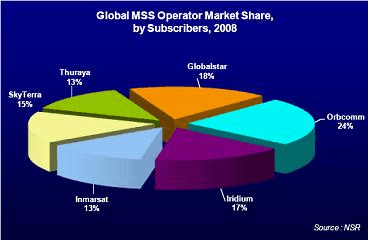
With less than 2 million subscribers, the main MSS players are generally holding their own as three constellations totaling 128 satellites in Low Earth Orbit and another 23 satellites in MEO and GEO could be launched in the next six years. This capacity surge is second to none since the origin of the sector and comes with high expectations that will either see the industry get a facelift with hundreds of thousands of new subscribers or go through an extreme makeover that could considerably reduce the number of operators. What lies ahead for the industry will depend on certain events, but at this point in time, not much has transpired to ascertain the market's aspiration for the coming months. However, NSR believes that a new look and feel for the business is more likely if certain events in preparation come through such as:
- SkyTerra and Inmarsat merging to provide them spectrum access that is second to none in North America
- Globalstar's increased foray into consumer products with a new version of the SPOT Messenger device
- Iridium's public listing once shareholders of GHL Acquisition approve its merger
- Thuraya's initial public offering (IPO) with the help of a resilient Middle-Eastern financial market
- Terrestar's new form factor smart phone launch in the consumer space through AT&T
- ICO's North American division reorganization (or sale) following its entry in May into Chapter 11 bankruptcy protection
- Eutelsat and SES ASTRA pulling out of Solaris Mobile after the recent S-band antenna failure on the W3A satellite
These developments could in some form shake-up the industry and help create more opportunities as well as grow revenues while strengthening the bottom line in the face of heightened competition from wireless and fixed-satellite services (FSS) operators.
in the short-term, for the operators with subscribers, the simple answer to negotiate the turbulence in the economy is to encourage existing subscribers to use the systems and also add new subscribers.
The earnings of MSS operators for the first two quarters of the year offered a picture that leaves mixed feelings in that regard. There are operators that have grown on the positive side on most indicators but with some red flags appearing in some areas of the business. Then, there were operators that continued to struggle and worked hard to find either a solid foundation in the market or a silver lining on the horizon.
One flag that changed colors for the top operators recently and is clearly a sign that could worry some is subscriber numbers, more specifically those actively using the systems and generating traffic revenues. In a filing that described its impending merger with GHL Acquisition, Iridium for the first time noted that a small percentage of the 328,000 subscribers it had acquired by 31 March 2009 were not using the constellation for communications. In other words, these subscribers maintained an account but were not generating revenues for Iridium. The company noted that it would "begin charging a nominal monthly fee for suspended accounts" to decrease this percentage that was still representing about 4% of all announced subscribers. This could mean that delays or suspension of activity on the network is simply due to ‘dormant’ users or that a number of users (about 13,000) have curtailed their use of Iridium devices. It is not clear which trend is dominant at this point, but what is clear is that the growth in subscriber equipment sales is affected. Other operators also report subscribers that are not necessarily ‘active’, and NSR has taken the view this misses the target in representing the true value of the MSS market.
Shipped equipment in the MSS business often represents a small percentage of total industry revenues, while the vast majority comes from retail service revenues. For example, machine-to-machine operator Orbcomm, which has declared 460,000 subscribers for its data-only services, changed its definition of a subscriber in 2007 such that this number may not all generate revenues. As for Globalstar, their new SPOT Messenger products, of which more than 120,000 units were shipped, are counted as subscriber units, but it is not known if these are all generating revenues from users as these are on annual subscription plans that may not all be renewed.
But beyond this methodology question lie the most important questions of the impact of the economy, which is the stated reason for Iridium’s second quarter decline in equipment sales of almost 26%. It is also likely that economics are affecting the (slow) transition of their handheld business from the older 9505 handsets to the 9555 units, launched already nine months ago. The operator realized however an important milestone to securing new subscribers with the launch of its IP-based OpenPort marine product in May. It also continued to show high growth rates on its machine-to-machine business, but if Iridium is to continue having success in the market and especially as it becomes a publicly traded company, it needs to do well not only in the lower revenue M2M market but also in the higher ARPU handheld and maritime business. Therefore, it would be sending a clear signal if it could ‘activate’ all of its possible users and secure new ones in emerging segments such as maritime vessels and commercial airlines.
Inmarsat, which reports only active subscribers, it also has many more thousands of units fielded than are reported. But the operator’s subscriber numbers were also affected when it discontinued R-BGAN service at the end of 2008 and removed 4,700 subscribers from the total number of users on the system. It is has not indicated if these users have migrated to the new BGAN system now operational across its fleet, but we could see that competition has grabbed some of them, especially in the Middle-East (Thuraya comes to mind). Furthermore, having added over 4,200 new subscribers in the first six months of 2009, Inmarsat is losing steam on BGAN subs compared to the blistering pace set in the first half of 2008 when it signed up almost 6,100 new users (and almost 12,000 for the year). The numbers for BGAN in Q3 should be on par with the current slower growth rate of 7% per quarter (around 2,000 new additions), but if competition increases, the operator has to hope that its land-mobile subscribers using the outdated mini-M and the former R-BGAN will migrate to the new service.
As for Globalstar, the drop of its voice subscribers is well known, and its satellites launched before 2007 no longer provide two-way S-band communications. It admitted that its decrease in sales comes from "two-way communication issues and lower subscriber equipment sales". With a retail average revenue per user (ARPU) that dropped 36% at the end of the second quarter compared to 2008 and overall revenues dipping by 32% in the same period, the company is hoping that in the short-term, subsidized equipment and more feature-rich land-mobile and maritime products will lead to subscriber growth and drive revenues. It could also be helped by new SPOT subscriptions on which its growing base of subscribers is based as a lifeline until the next-generation satellite constellation is in orbit.
SkyTerra also lost some subscribers this year, and the associated revenues were down 10% for voice, while data was curtailed by 30%. It is more likely that it could see a rise in subscribers and ARPU if the push-to-talk groups set-up mostly among first responders and government users have a busy hurricane season. However, it is not likely to see formidable growth outside of the wholesale capacity business for private networks, which have many hundreds of thousands of users.
Bottom Line
All in all, the underlying current on subscriber numbers is that they are slowing their consumption of MSS products and services, and some of them are simply shutting down their equipment due once again to the economy. If operators are looking at the calendar regularly, they know that the next quarter is well underway and that the push to meet end-of-year results is on and that the name of the game is subscribers...and lots of them.
------------------------------------------------
Information for this article was extracted from the NSR report entitled: Mobile Satellite Services, 5th Edition. For more information go to www.nsr.com