



by Aishwary Pachauri
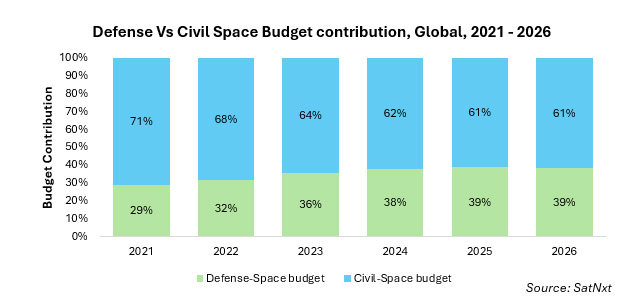
Bengalaru, India, September 3, 2026-- For decades, government space budgets were viewed mainly through civil ambition: lunar and Mars missions, Earth observation, human spaceflight, science, and national prestige. Agencies such as NASA, ESA, JAXA, ISRO, Roscosmos, and CNSA shaped this public narrative. That story still matters, but it no longer captures the full picture. Between 2021 and 2026, military space organizations became some of the fastest-growing budget centers in the global space economy.
SatNxt’s Global Government Space Budget & Spending Analysis Report (2021–2026), based on 44 space agencies and organizations, shows global government space spending rising from approximately US$ 94.4 Billion in 2021 to US$ 125.9 Billion in 2026, with cumulative spending exceeding US$ 688 Billion. The headline growth is important, but the composition is more revealing: governments are increasingly treating space as a strategic layer of national security, sovereign capability, economic competitiveness, and critical infrastructure.
Military Space Is Driving the Growth Curve
The strongest signal in the data comes from the major military space organizations. The U.S. Space Force / DoD Space budget increased from US$ 15.4 Billion in 2021 to US$ 26.3 Billion in 2026, making it the largest government space organization by annual budget in 2026. China’s PLA Space Forces expanded from US$ 8.0 Billion to $10.5 Billion, while Russian Space Troops nearly tripled from $4.0 Billion to $11.7 Billion. Together, these three organizations increased annual spending from approximately US$ 27.4 B to US$ 48.5 Billion, adding more than US$ 21 Billion during the period.
This matters because overall government space spending grew by about US$ 31.5 Billion over the same period, meaning these three military-space organizations accounted for roughly 67% of total budget growth. Civil programs remain large and strategically important, but the growth momentum has clearly shifted toward defense-space requirements.
Geopolitics explains part of the acceleration. The Russia-Ukraine conflict demonstrated how satellite communications, Earth observation, intelligence, navigation resilience, and commercial space infrastructure can influence real-time operations. Intensifying U.S.-China competition has also reinforced investment in missile warning, secure communications, space domain awareness, resilient architectures, and sovereign access to orbital infrastructure.
Civil Space Remains Essential, but Its Role Is Evolving
Civil space is not losing relevance. Civil agencies remain central to exploration, Earth observation, climate monitoring, navigation, space science, launch systems, and industrial capability building. Programs such as Artemis, Copernicus, Galileo, IRIS², Gaganyaan, and Chandrayaan show that civil space remains a foundation of long-term economic and technological policy.
What is changing is the operating role of civil spending. Earth Observation remains the largest application category, reaching approximately $30.1B in 2026, but its value now extends beyond science and environmental monitoring into defense planning, disaster response, agriculture, infrastructure, climate resilience, energy transition, and financial risk assessment.
 Three Major Powers, Three Strategic Models
Major space powers are using budgets to pursue different strategic outcomes. The United States is using space investment to maintain technological leadership and operational superiority, with growth concentrated in resilient constellations, missile warning, secure communications, space domain awareness, rapid acquisition, and commercial integration. Its model increasingly combines government demand with private-sector execution.
China is building a sovereign and self-reliant architecture across launch, Earth observation, navigation, communications, exploration, and military-space capabilities. From Tiangong and lunar exploration to BeiDou and PLA space systems, its objective is full-spectrum autonomy and long-term strategic leverage.
Russia is using space budgets to preserve strategic resilience under geopolitical and economic pressure, with emphasis on sovereign communications, navigation, ISR, and space security systems in a contested environment.
Together, these models point to the same conclusion: space budgets are becoming tools of national positioning. The old distinction between civil prestige and military utility is giving way to a dual-use infrastructure layer where satellites, launch capacity, navigation, communications, and data networks serve both economic and strategic priorities.
The Real Question Is Capability Conversion
For policymakers and industry participants, the defining question for the next decade is not simply who spends the most, but who converts space budgets most effectively into operational capability, industrial depth, strategic autonomy, and long-term advantage. Countries that integrate civil programs, defense requirements, commercial innovation, and domestic supply chains will be better positioned than those treating them as separate policy tracks.
The future space economy will be defined less by a clean military-versus-civil split and more by convergence. Earth observation, satellite communications, positioning and timing, launch, space situational awareness, and data infrastructure are all moving toward dual-use relevance. Successful national strategies will recognize this early and align funding, procurement, regulation, and industry participation around it.
Conclusion: Space Has Become Critical Infrastructure
SatNxt’s analysis shows government space spending moving from an exploration-led model toward an infrastructure-and-security-led model. Civil agencies will continue to drive science, exploration, climate monitoring, and technology development, while military organizations accelerate investment in resilience, secure connectivity, navigation, ISR, and operational architectures. Increasingly, both sides will depend on the same industrial base, orbital assets, data systems, and commercial partners.
As space becomes critical infrastructure, the distinction between civil value and strategic value will continue to blur. Countries that build resilient, scalable, and commercially integrated space ecosystems will have a stronger foundation for national security, economic growth, and technological sovereignty.
Call to action: For government agencies, satellite operators, defense organizations, investors, and space-industry suppliers, the priority is to understand where budgets are shifting, which applications are gaining strategic weight, and how procurement priorities are evolving across major space economies. SatNxt’s Global Government Space Budget & Spending Analysis Report (2021-2026) provides the detailed country-level, agency-level, and application-level view needed to assess these opportunities and risks. To explore the full dataset and understand how government space spending is reshaping the global space market, connect with SatNxt. (www.satnxt.com)
----------------------------------

Aishwary Pachauri is a Consultant at SatNxt. Aishwary is a strategy and growth consultant with over a decade of cross-sector leadership experience spanning finance, space, education, and building materials industry. He specializes in commercial strategy, corporate planning, pricing architecture, and data-driven market expansion initiatives. His consulting portfolio includes advising clients across India, and the USA, delivering actionable insights for geographic expansion and revenue optimization. At SatNxt, he brings a global, cross-functional perspective to market intelligence and strategic advisory engagements, helping organizations translate complex insights into scalable growth strategies. He can be reached at: aishwary@satnxt.com