



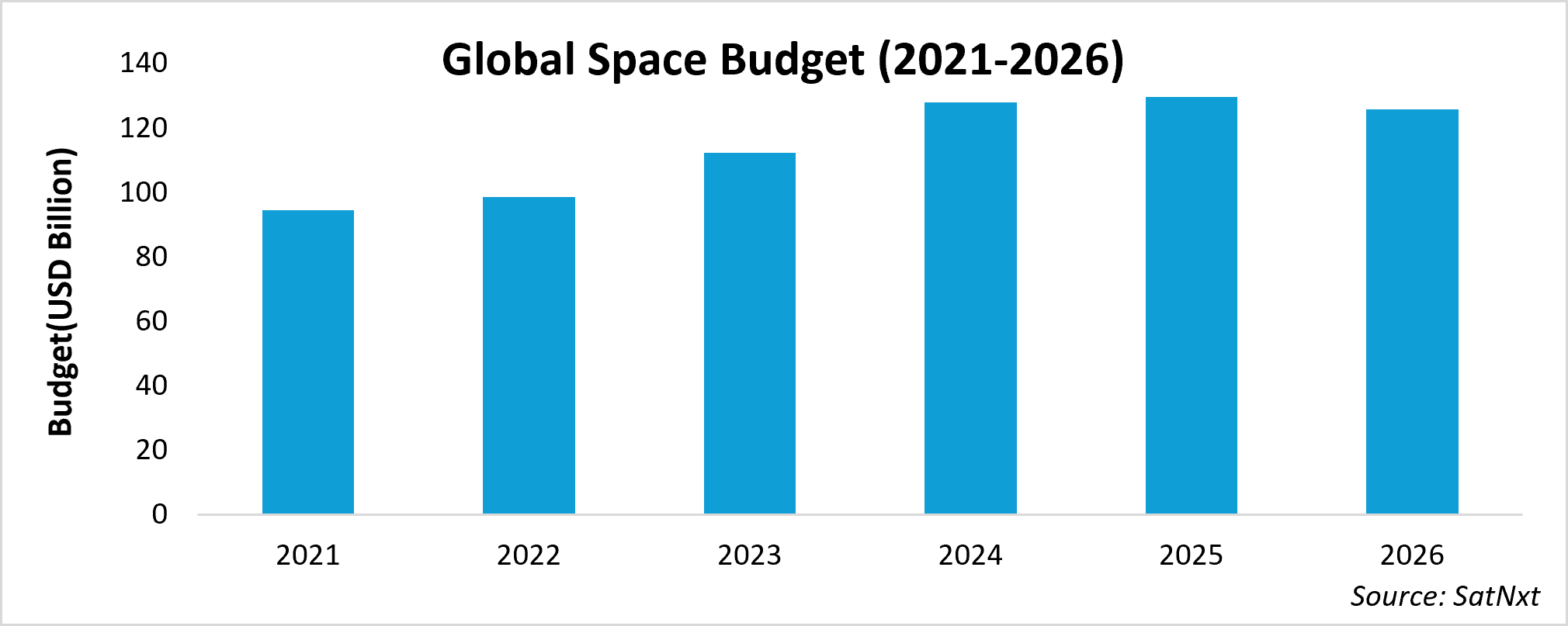
Bengalaru, India, July 14, 2026: Global government space spending grew from approximately US$94.4 billion in 2021 to US$125.9 billion in 2026, representing more than US$688 billion in cumulative expenditure over six years, according to a new study by SatNxt. The Global Government Space Budget & Spending Analysis Report (2021–2026) provides a comprehensive assessment of how civil and defense space budgets are evolving across the world's leading and emerging space nations.
"Government budgets remain the single largest driver of the global space economy. While overall spending continues to rise, the more important story is where governments are allocating capital and how spending priorities are shifting from exploration-led programs toward operational infrastructure, security, Earth observation, communications, and sovereign capability development," said Aishwary Pachauri, Lead Author and Consultant, SatNxt.
The report highlights a fundamental transformation in the global space landscape. While the world's three largest agencies continue to dominate spending, their collective share declined from nearly 60% in 2021 to approximately 53% in 2026, indicating the emergence of a more distributed and multipolar space ecosystem. Governments across the Middle East, East Asia, Eastern Europe, and emerging space nations are increasingly expanding investments in strategic space capabilities.
The analysis identifies Earth Observation, Satellite Communications, and Navigation as the largest spending categories globally, reflecting the growing operationalization of space infrastructure. At the same time, defense-space organizations such as the U.S. Space Force, PLA Space Forces, and Russian Space Troops have become major contributors to global budget growth as space increasingly becomes a critical domain for national security and resilience.
Recent policy developments continue to reinforce this trend. Governments worldwide are expanding investments in sovereign satellite infrastructure, national security capabilities, climate-monitoring systems, resiliency architectures, and commercial procurement models. Public-private partnerships and commercial participation are becoming increasingly important mechanisms for capability development across both civil and defense programs.
SatNxt's Global Government Space Budget & Spending Analysis Report (2021–2026) provides agency-level, application-level, regional, and strategic analysis of government space spending worldwide. The report covers 44 government space agencies across 12 global regions, evaluating budget evolution, application allocation, spending concentration, policy impacts, and long-term strategic priorities.
Using a standardized bottom-up methodology, the report tracks spending across Earth Observation, Communications, Navigation, Space Transportation, Human & Robotic Exploration, Space Science, Technology & Innovation, and Space Operations & Infrastructure. Budget changes are linked to major programs, policy reforms, geopolitical events, and strategic initiatives to provide deeper context behind spending trends.
- How has global government space spending evolved between 2021 and 2026?
- Which agencies and countries account for the largest share of global space budgets?
- How are civil and defense space spending priorities changing?
- Which applications receive the highest levels of government investment?
- How have major geopolitical, policy, and programmatic developments influenced budget allocation?
- Which regions are emerging as significant growth centers within the global space economy?
- How are agencies such as NASA, ESA, CNSA, US Space Force, JAXA, Roscosmos, ISRO, and others evolving their spending priorities?
NASA, US Space Force, ESA, UK Space Agency, CNSA, PLA Space Forces, JAXA, KARI, Taiwan Space Agency (TASA), ISRO, SUPARCO, Roscosmos, Russian Space Troops, Saudi Space Commission, UAE Space Agency, Israel Space Agency, Turkish Space Agency, Canadian Space Agency, Australian Space Agency, and other leading government space organizations.
North America, South America, Western Europe, Eastern Europe, East Asia, South Asia, Southeast Asia, Central Asia, Middle East, North Africa, Sub-Saharan Africa, and Australia & New Zealand.
For more information go to: https://www.satnxt.com/reports/global-government-space-budget-spending-analysis-2021-2026