



The availability of wireless access to the Internet away from the home or office is not only becoming more pervasive, but consumers are actively seeking it out. A 2009 study by Wakefield Research for the WiFi Alliance indicated that 79% of the 480 business-class passengers polled would take the availability of in-flight Internet into account when choosing an airline.
Los Angeles, October 15, 2010--The availability of wireless access to the Internet away from the home or office is not only becoming more pervasive, but consumers are actively seeking it out. A 2009 study by Wakefield Research for the WiFi Alliance indicated that 79% of the 480 business-class passengers polled would take the availability of in-flight Internet into account when choosing an airline.
What do we mean by “in-flight Internet”? For our purposes, “in-flight Internet” provides Internet connectivity for passengers of commercial airlines in a way that does not interfere with the safe operation of air craft instruments. This connectivity can be through WiFi, Ethernet cables or a seatback screen. There are companies that provide connectivity to privately owned aircraft and other vehicles, such as Yonder by ViaSat, however we will be focusing on service intended to be sold or re-sold to passengers of commercial airlines.
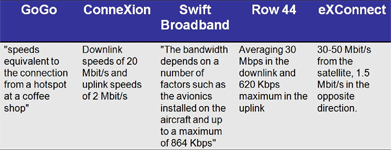
When comparing the download/upload speeds claimed by the various providers, some give the speeds seen by the end user passenger, while others advertise the speeds provided by the service as a whole. However, GoGo Inflight’s claim of speeds “equivalent to the connection from a hotspot at a coffee shop” appear to be the norm across the board from the consumer’s point of view. This is the sort of service consumers have come to expect from Internet access away from their home, office or hotel room.
The earliest example of in-flight Internet to commercial passengers was the Connexion by Boeing service, commercially available in 2004. Aircraft for companies such as Lufthansa and Korean Air were equipped with a phased array Ku-Band antenna and later a low-profile mechanically-steered antenna designed and produced by Mitsubishi Electric Company. Connexion had transatlantic coverage, including Western Europe, the “lower 48” of the US and much of Central America. This was achieved using four satellites; AMC 4, Telstar 5, Intelsat 709 and Eutelsat II F4. Consumers were able to connect to the Internet using either an Ethernet cable or WiFi. In 2006, the commercial end of Connexion was shut down. Several reasons have been sited for this, including a number of airlines pulling out of the project, possibly as a result of post 9/11 decreases in travel.
Since then, airlines have become more interested in making the commitment to providing in-flight Internet. A 2009 study by In-Stat indicates that by the end of 2010, there will be approximately 2,000 commercial aircraft deployed with some sort of Internet service. North American and international service includes offerings from OnAir, GoGo Inflight, Row 44, eXconnect and Inmarsat.
GoGo Inflight by AirCell, first available in 2009 on Virgin America, is the current leader in North America using a ground based system and bandwidth taken over from AirPhone. Roughly 98 cell towers turned upwards across the lower 48 of the US and Canada provide coverage for the AirCell Iridium Blade antenna installed on aircraft from Virgin America, United, US Airways, Continental and Air Canada, among others. The service is fast enough for my iPhone to stream music from an Internet radio station like Pandora.com or last.fm and provide a pleasant listening experience.
Swiftbroadband by Inmarsat uses the three L-band I-4 satellites which provide near global coverage. There are a number of compatible antennas for commercial applications of the service, one example of which is the CMA-2102SB by Esterline CMC Electronics. The Swiftbroadband service was launched in 2005 and is currently being utilized by OnAir and AeroMobile. OnAir was founded in 2005 by AirBus and SITA. It provides connectivity to passengers through WiFi. The service is popular with European and MENA airlines such as TAP Portugal, Royal Jordanian, British Airways (transatlantic flights from London City Airport to JFK only) and Air Blue among others.Row 44 was founded in 2004 by John Guidon and Gregg Fialcowitz. In 2009, Southwest airlines began testing Row 44’s service on four of their planes. Since then, they have continued to equip their aircraft with Ku-band antennas providing WiFi accessible Internet through the HughesNet capacity leased by Row 44. It is estimated Southwest’s entire fleet will be equipped with the service by 2013. The company's service can provide Internet access, live television and cell phone services (if permitted) for commercial air passengers. They are also able to provide airline operations services for cockpit and crew.
eXConnect was formed in 2008 by Panasonic Avionics. The service, providing Internet and other entertainment by WiFi, Ethernet or seatback screen, should be available towards the end of 2010 or the early part of 2011 on Lufthansa as the newly reformed “FlyNet” (originally provided by Connexion by Boeing). For Lufthansa, eXConnect will use the already base of Connexion Ku-band antennas but is currently exploring the possibility of hybridizing their network into Ka as well. eXConnect’s dual-panel tracking antennas are produced primarily (though not exclusively) by EMS Technologies. Cathay Pacific is currently slated to begin using eXConnect in 2012 with three unannounced potential clients to follow.
The In-Stat report on in-flight Internet equipment investment and service adoption indicates that, in 2009, an estimated 2% of seats on Internet-equipped flights used the service. However, the Wakefield/WiFi Alliance study showed that 71% of their business-class passengers said they would prefer Internet access to meal service on cross country flights and 79% would rather have Internet then a free movie. A study done by Alaska Airlines with Row 44 (before switching to GoGo Inflight as their provider) covered flights involving nearly 3,000 commercial passengers. The correlation between people who tried the service and planned on using it again was nearly unanimous. However, they discovered when they charged a $1 connection fee, usage dropped off significantly. In an interview with CNN International (Oct. 14, 2009), Ron LeMay, President and CEO of Aircell, countered that the tests were done on very short flights. He argued the longer a flight is, the more attractive the service becomes to the passenger. LeMay indicated they have seen “people paying the full fare” (for the service) growing by 6% per week.
Price-wise, GoGo Inflight has the advantage of having the lowest advertised price to the consumer with rates from $4.95 - $12.95 depending on the length of the flight, including a 30-day pass for $29.95 providing the user access on any airline equipped with GoGo.
GoGo’s terrestrial based service is pulling ahead in brand recognition and a degree of acceptance. However, both terrestrial and satellite in-flight Internet has been proven from a technical point of view. With 94% of the business-class travelers polled by Wakefield for WiFi alliance agreeing that adding Internet to flights is the best thing airlines have done for their customers in the last three years, it seems that it’s been proven from a consumer view as well. Going international and global the satellite based services face financial and coverage challenges, although Inmarsat and others offer satellites that can serve the required flight routes. There is still an excellent potential as proven on-the-move technologies give an edge that can bring them to the fore and create viable businesses.
----------------------------
Michelle Elbert is the Director of Marketing of Satellite Markets and Research and concurrently a consultant with Application Technology Strategy, Inc. She has extensive experience in the satellite and IT industries and has an M.B.A. from Concordia University. She can be reached at: michelle@satellitemarkets.com