



When looking at the pie of advanced satellite equipment market, it is not surprising to find that the lion’s share of projected sales falls within the DTH sector. DTH operators need MPEG-4 and DVB-S2 technologies to offer advanced TV offerings and differentiate against cable triple-play and VOD. Such differentiating consumer services enabled by advanced receiver hardware play a particular relevance in the saturated North American pay TV market, exercising upward pressure on subscriber acquisition costs, but offset by declining costs of advanced hardware.
In its Advanced Satellite Coding and Modulation, 2nd Edition research study, NSR analyzed the use of advanced equipment in satellite delivered scenarios. For the DTH sector, such analysis focused on identifying trends and producing forecasts for the installation of advanced equipment at customer premises and DTH teleports. Advanced DTH equipment analyzed comprised MPEG-4/DVB-S2 set top boxes and DVRs, MPEG-4 AVC video encoders and full-transponder DVB-S2 modulators. The DTH analysis projects that advanced set top boxes and DVRs in particular will account for over 95% of global advanced equipment shipments between 2009 and 2014.
The North America Replacement Market for Advanced DTH Receivers
In developed economies with high pay TV penetration, the DTH business is often characterized by high-ARPU and low subscriber growth. North America has over 85% pay TV penetration and a large base of HD-ready households. Such a situation coupled with the so-called "HDTV Gap" -the difference between those who own an HDTV and those who have an HD set-top box- makes the push for advanced HD services by DTH operators an ARPU-enhancing opportunity as well as a defense mechanism against cable.
Since the total number of DTH subscribers is not projected to growth significantly, the North American DTH sector for advanced end user equipment is primarily a replacement market. With hundreds of linear HD channels available, existing DTH subscribers are expected to upgrade to HD and/or DVR services. Lowering equipment costs will also tend to favor the use of MPEG-4-ready equipment in new installations, as operators gradually phase out refurbished MPEG-2 receivers. NSR projects that by 2014, 87% of the DTH subscriber base in the U.S and Canada will be receiving services in MPEG-4-enabled receivers (set top boxes and DVRs) regardless of whether all users subscribe to linear HD offerings.
The combination of the cable pressure, less expensive HD-DVRs able to decode on-demand content with (Blue-Ray-like) 1080p quality and a large and growing addressable market of HD-ready households leads NSR to believe that the market for advanced equipment in North America is likely to hold up well in the current economic cycle. In fact, as a result of more evidence of such trends, forecasts for North America advanced equipment sales were revised upwards from the previous study.
NSR developed bottom-up forecasts that model the actual process involving the addition of subscriber hardware to the DTH network. Equipment growth factors were associated with both upgrades and gross additions because churn, while negative in nature, provides an opportunity for the DTH operators to ship advanced equipment in new installations and grow the addressable advanced equipment base. NSR used in its forecasts a gradual remix of equipment types shipped in gross additions, dependant on regional and local market conditions. A more detailed explanation of why NSR remains optimistic about the North America advanced DTH receiver market requires observing metrics for the two leading regional operators (DirecTV and Dish Network), which together account for over 90% of the region’s DTH subscriber base.
U.S. SAC Hikes Indicate Further Push for Advanced Receivers
After payment to content providers, subscriber acquisition costs (SAC) are the largest investment factor in DTH. Increasing SAC via marketing promotions and receiver hardware subsidies tends to simultaneously increase net additions and reduce or contain churn.
The DTH business is often analyzed through the glasses of key performance metrics that include terms such as gross and net subscriber additions, monthly churn rate, ARPU and subscriber acquisition costs (SAC). These performance factors are all related. Churn, net and gross additions have, in fact, a straightforward relationship as shown below.
However, the relationship between churn, net additions, SAC and ARPU is not straightforward. SAC is typically negatively correlated with churn rates, while ARPU tends to show a direct correlation with churn. The cause and effect of such correlation usually works as follows: SAC rises and ARPU drops attract more subscribers and prevent existing subscribers from leaving, thus resulting in lower churn rates. Naturally, the trick is balancing these variables in order to maximize profits, which typically means managing trade-offs towards maximizing ARPU (and profitability) while minimizing or containing churn and SAC.
The tables and charts below show how these factors have performed between 2005 and 2008 for the two U.S. DTH operators. A key difference between DirecTV’s and Dish Network’s performance can be related to how aggressively the companies promoted additions and upgrades to their advanced services (DVR and HD).
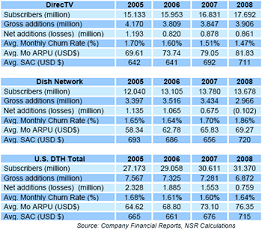
DirecTV has historically shown a rather conservative, ARPU-driven approach, while Dish Network has been growth-driven (relative to DirecTV). For a number of reasons that include differences in brand power and distribution capabilities, Dish Network historically trended towards higher SAC and lower ARPU, reflecting more dependency on lower-income households to grow its subscriber base. However, in 2006 Dish Network began to lower its SAC at the same time as DirecTV began increasing it. By 2007, influenced by hardware subsidies on advanced set top boxes and DVRs, DirecTV had increased its SAC from $642 in 2005 to $692 in 2007. Dish, instead, lowered its SAC from $693 in 2005 to $656 in 2007.
No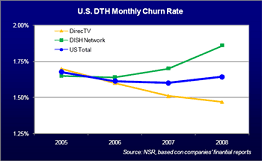 t surprisingly, churn rates responded to such changes and began to diverge. 2008 ended with an average churn rate of 1.47% for DirecTV (lowest in four years) and 1.86% for Dish (highest since 2005). Such divergence was also influenced by the economic downturn and Dish’s higher exposure to low-income households, as well as the break-up with long standing triple-play partner AT&T. This churn changes, in turn, impacted net subscriber additions. DirecTV ended 2008 with record-setting results including the lowest churn rate in 9 years and its highest operating profit (OPBDA) in history. Dish, however, ended 2008 with its biggest-ever drop in subscribers.
Maximizing Subscriber’s Lifetime Value
Maximizing subscriber’s lifetime value is not necessarily related to increasing SAC but rather doing so selectively. Taking the DirecTV performance as an example, such a strategy has clearly proved to work excellently. Through strict credit polices and focus on high-income, advanced-service receptive households, DirecTV was able to substantially increase the net present value of its advanced subscribers. In December 2008 UBS 36th Annual Global Media and Communications Conference, Jon Rubin, Sr. VP of Financial Planning and Investor Relations reported that the internal rate of return (IRR) of DirecTVs advanced subscribers was 66% for 2008, compared with 18% IRR for a basic subscriber. Advanced subscribers also showed a higher variable margin, 47% against 34% for basic subscribers.
The answer to such performance is purely related to making the right investments. DirecTV smartly invested more heavily in advanced subscribers than in basic subscribers. As a result of HD promotions and subsidies on MPEG-4/DVB-S2 set top boxes and HD-DVRs, DirecTV reported $750 SAC for advanced subscribers, versus $600 for basic subscribers. The IRR difference among the two user groups, however, is more heavily influenced by the lower churn rates that characterize advanced services. At an average advanced subscriber monthly churn of 1.1%, advanced subscribers are expected to stay with DirecTV for 91 months (1/ 1.1%); or 7.5 years, versus 52 months (1/ 1.8%; less than 4.5 years) for basic subs. Therefore, an increase in SAC on advanced customers leads to much higher net present value thanks to the combined effect of higher profit margins and longer permanency.
Dish Network has clearly taken note of the need to invest in advanced subscribers, as evidenced by the spike in SAC for 2008 and its publicly made intentions to accelerate MPEG-4 device penetration. Regional SAC is expected to remain high as the mix of advanced subscribers grows, implying that operators will increase the hardware subsidy volume, helped in turn by lowering equipment costs. As advanced equipment price continues to drop and the advanced subscriber base grows, advanced subscriber churn will increase and begin to approach basic subscriber churn as a result of cable / telco competition and because services will begin to capture households with lower disposable income. However, NSR expects that the effect of lower equipment cost and push for consumer-valued DVR will outweigh lower service margin and higher churn rates, resulting in NPV-positive advanced DTH subscribers.
Conclusion
Despite the economic downturn and tightening of the credit markets, NSR expects that the "HDTV gap" and competitive pressures are in fact further fostering the adoption of advanced MPEG-4/DVB-S2 set top boxes and HD-DVRs among North American DTH operators. U.S. DTH operators have learned the lesson that investing smartly in valuable subscribers pays off. Taking 2008 U.S. SAC as a predictor, NSR expects further push for advanced end user equipment. SAC will possibly continue an upward trend as the mix of HD set tops and DVRs in gross additions and upgrades grow, exercising upward customer acquisition cost pressure, partially offset by declining costs of advanced hardware.
Information for this article was extractedfrom the NSR report entitled: Advanced Satellite Coding and Modulation, 2nd Edition