



by Virgil Labrador, Editor-in-Chief
Very Small Aperture Terminals or VSATs for short, have been widely adopted for network and connectivity applications globally by virtually every major industry including retail, enterprises, banks, financial institutions, transportation, logistics, utilities, mining, oil & gas and government agencies and the military, among others. If you have ever used an ATM at a bank or paid at a pump at a gas station, your transaction most likely went through a VSAT network. According to most estimates, there are currently over 5 million VSAT terminals deployed worldwide and the number of terminals are forecasted to more than double in the next decade.
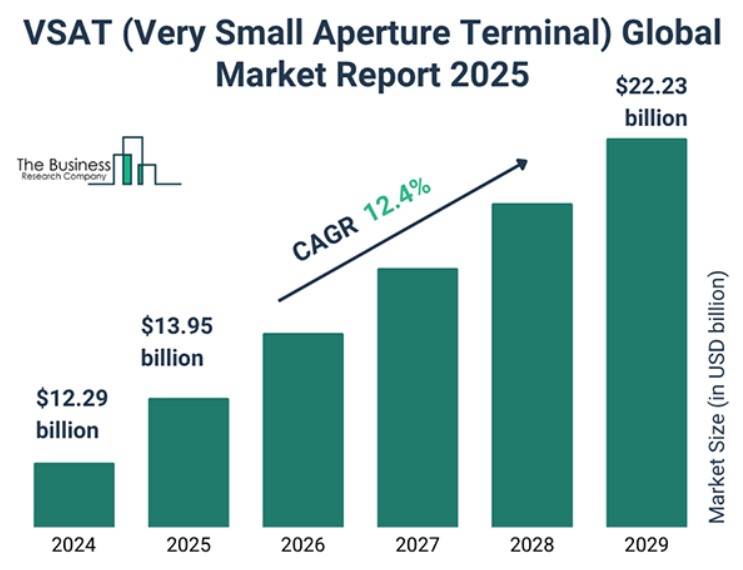
The VSAT market is estimated to be valued at US$ 13.95 billion in 2025 and is projected to reach US$ 22.23 billion by 2035, a compound annual growth rate (CAGR) of 12.4% over the forecast period according to The Business Research Company.
The growth in the VSAT market is driven by increasing connectivity needs in maritime, aerospace, oil & gas, and government and defense sectors. Of these sectors, the government segment has the potential for the highest growth in the next few years. From 2025–2030, the market will rise to approximately US$ 23.8 billion, adding US$ 7.7 billion, or 40% of the total opportunity, fueled by increasing adoption of broadband services in remote industrial operations and enterprise networks according to Future Market Insights (FMI). From 2030–2035, the market will increase by another US$11.5 billion, accounting for 60% of incremental growth, as satellite constellations expand and high-throughput satellites (HTS) gain traction for low-latency applications. Annual increments will grow from USD 1.3 billion in early years to US$ 2.9 billion by 2035, indicating accelerated adoption in emerging markets and defense modernization programs. Companies investing in flexible VSAT platforms, software-defined networks, and Ka-/Ku-band capabilities will capture significant value in this US$19.2 billion growth window, especially as demand for global connectivity and cloud integration continues to rise in remote and offshore environments according to FMI.
How VSAT Works
A VSAT network is a satellite communication system typically comprising of remote terminals and a central hub or teleport, which manages the network. The terminals consist of a dish antenna, a modem, and a set of equipment that facilitates two-way communication with the satellite. VSAT technology enables the transmission of data, internet, voice, and video at high speeds, making it ideal for areas where traditional wired communication infrastructure is limited or nonexistent.
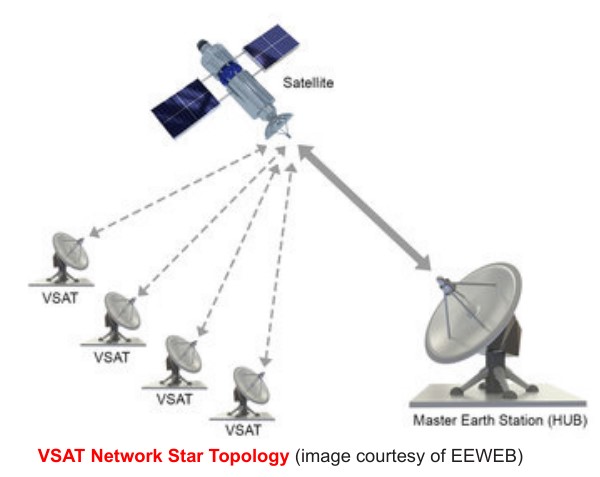 |
VSAT Network Star Topology (image courtesy of EEWEB)
VSAT networks can be one of two topologies: a Star or a Mesh network. The star network is the most commonly used topology for both unidirectional and bidirectional networks providing much greater flexibility. This network allows transmission of information in both directions but cannot be transmitted directly from one VSAT to another. All information is routed through the hub station. See the case study on page 8 for an example of a star network solution.
In a mesh topology, there are multiple paths for data transmission as each terminal is connected to at least two other terminals, ensuring built-in redundancy. Mesh networks can be complicated to manage compared to star networks and would require more investment in equipment.
VSAT networks have been widely adopted primarily due to its ability to provide a uniform level of services to many disparate sites spread over large geographic areas. With a VSAT network you can be assured of the same level of service and reliability using uniform equipment from point to multipoint, even beyond national borders, across continents. There doesn’t even have to be any infrastructure in the remote site. VSATs can be installed almost anywhere. VSAT networks are a very cost-effective way of connecting various remote sites compared to other terrestrial networks such as cable or fiber. VSAT networks are also highly scalable, making it easy to expand the network as the demand for connectivity increases.
 |
Government Applications
The cost-effectiveness, scalability and reliability of VSAT networks for connecting multiple sites provide distinct advantages for the government market. As mentioned earlier, the government/defense segment is one of the fastest growing segments of the VSAT market.
Some of the key applications of VSATs for the government sector include the following:
- Broadband Access. Hard to believe but in this day and age there are still almost four billion people, nearly half the world’s population, that still don’t have internet access according to the International Telecommunications Union (ITU). Governments all over the world are developing programs that will enable high-speed internet services to rural areas, providing access to essential services such as healthcare, education, and economic opportunities.
- Education. In many countries, particularly in developing regions many of the schools are situated in the more remote areas. Traditionally, access to education has been limited by factors such as infrastructure, geographic isolation, and socio-economic barriers. Satellite technology can level the playing field by breaking some of these barriers. Connecting schools in remote areas enables institutions to transmit lectures, courses, and educational resources directly to students who might otherwise have limited or no access to such materials.
- Telemedicine. Lack of access to healthcare and medical services in rural and remote regions is a major issue in many countries. VSATs can provide crucial communication between remote specialists and local medical staff engaged in on-the-ground healthcare. With high-speed connectivity, test results, diagnostic images and videos can be transmitted enabling rapid diagnosis and assistance. Connecting these remote areas will also provide access to vital health information that can aid government agencies in planning health strategies and allocating resources to areas that need it the most.
- Disaster Response. Natural disasters such as earthquakes, hurricanes, fires and floods, all too results in disruption of communications services on the ground. Mobile VSAT installations can be used to set up local WiFi hotspots, enabling first responders and Non-Governmental Organizations ( NGOs) to communicate with each other and the outside world, facilitating relief efforts. Those Wifi hotspots, can also be used by residents impacted by the disaster, to communicate with concerned family and friends.
- Defense. Tech Insights forecasts that global military VSAT expenditure will approach US$ 1.9 billion by 2031, a ten-year CAGR of 3.8%. Combat aircraft will be the largest segment in military VSAT expenditure. This growth is fueled by increasing bandwidth demand amid increasing air to air and air to ground network connectivity and uptake of software-defined digital and solid-state technologies.
Managed Network Services
Designing, installing and managing a VSAT network involves meticulous planning and requires a high level of technical expertise. It is vital that one should choose carefully when looking for a service provider for VSAT network services. The key qualities to look out for include: experience, technical expertise, reliability, customer service and support, among others.
“In the government VSAT market, Es’hailSat delivers a comprehensive portfolio of services designed to address the unique demands of public sector clients. Our offerings include secure, dedicated satellite connectivity for government agencies, supporting applications such as confidential communications, emergency response, mobility services, and remote site connectivity. We leverage advanced VSAT technology to ensure robust network reliability, high data throughput, and scalable bandwidth options—enabling critical command-and-control operations, field deployments, and real-time information sharing across dispersed locations,” said Jarod Lopez, Executive Director-Marketing and Business Development of Es’hailSat.
Es’hailSat’s network architecture is engineered with multiple layers of security and encryption, meeting stringent national and international standards to safeguard sensitive data.
The company has multiple certifications including ISO 45001:2018 certification for Occupational Health and Safety Management Systems and ISO 20000-1:2018 for IT service management systems. Subsequently, the company received ISO 14001:2015 certification for Environmental Management Systems and ISO 9001:2015 for Quality Management Systems.
Es’hailSat provides tailored network management, proactive monitoring, and 24/7 technical support, ensuring mission-critical government operations receive uninterrupted service and rapid response. “Es’hailSat’s deep understanding of governmental priorities allows us to adapt service levels and solutions to each client’s operational environment, empowering agencies to operate with confidence in any scenario.,” added Lopez.
Es’hailSat
Es’hailSat, a Qatar-based satellite communications company currently operates two satellites, Es’hail-1 and Es’hail-2, covering the MENA region. The company’s main hub is a 50,000 square meter state-of-the art teleport located in Doha. The teleport has recently been awarded Tier 4 certification from the World Teleport Association (WTA). Tier-4 is the highest level of excellence recognized by the WTA.
The company is well on its way towards becoming a global satellite operator with the planned launch in the next few years of the Es’hail-3 satellite, extending the company’s coverage beyond the MENA region.
Es’hailSat’s VSAT services provide high-speed, resilient communication via Ku-band and Ka-band satellites, ensuring secure data transmission for government operations in remote, maritime, and mobile environments. Among the key advantages Es’hailSat offers to its VSAT clients include:
- Excellent satellite footprint across the MENA region.
- Disaster recovery readiness with two satellites.
- Data Security. Supports encryption standards from IPSec VPN to Quantum-Safe Cryptography. Es’hail-2 satellite provides greater capability for anti-jamming protection.
- End-to-End Managed Service with 24/7 Support. The offering includes hardware provisioning, installation, network monitoring, and proactive maintenance, supported by certified field engineers and round-the-clock technical assistance.
- 24/7 dedicated VSAT Operations team andNetwork Operation Center.
- Customizable Bandwidth and Service Level Agreement (SLA) Options. Government clients benefit from flexible bandwidth plans and SLAs tailored to mission-critical needs, with the ability to scale or reassign bandwidth from a secure pool.
- Flexible Service Plans. Dedicated vs. shared bandwidth, on-demand allocation.
- SLA compliance tracking and reporting.
- Integration with Terrestrial and Cellular Networks. VSAT solutions are designed to integrate seamlessly with existing telecom infrastructure, supporting applications such as cellular backhaul, disaster recovery, and military-grade communications.
- Strong & strategic partnership with local telecommunication operators. This facilitates the integration of satellite communication with the terrestrial services.
- Operational Efficiency and Cost Optimization. Through optimized engineering design, Es’hailSat ensures high quality of service and low contention ratios, enabling significant cost savings without compromising performance. Ensuring predictable performance for high-priority government missions. Offers cost-saving models, including bandwidth pooling across agencies and seasonal scaling.
All of the above, are vital considerations when evaluating a VSAT service provider.
---------------------
 Virgil Labrador is the Editor-in-Chief of Los Angeles, California-based Satellite Markets and Research which publishes a web portal on the satellite industry www.satellitemarkets.com, the monthly Satellite Executive Briefing magazine and occasional industry reports called MarketBriefs. Virgil is one of the few trade journalists who has a proven track record working in the commercial satellite industry. He worked as a senior executive for a teleport in Singapore, the Asia Broadcast Center, then-owned by the US broadcasting company CBS. He has co-authored two books on the history of satellite communications and satellite technology. He holds a Master’s in Communications Management from the University of Southern California (USC). He can be reached at virgil@satellitemarkets.com