



Having spent most of my adult life in Greater China, South Korea has always been on the periphery: a place that I know somewhat well (I have spent around 6 months in total living there and have a Korean partner), but have not had the chance to really dig into in a space industry context. Until June 2025, when I was invited to speak (on the topic of China, of course) at the International Space Summit (ISS), an event hosted by CONTEC.
Taking place in Daejeon, South Korea’s Space City, the conference was a blend of East and West in more ways than one, and offered a fascinating peek into an up-and-coming space ecosystem that includes by some estimates 150ish companies. Let’s dig in.
Resembling China in Industrial Development and Support
 |
|
|
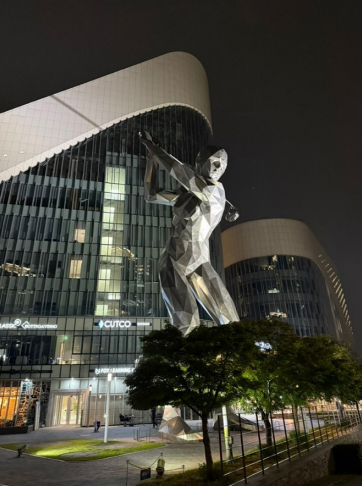
The Giant Polygonal Golfer Across the Street from the Daejeon Expo Center. |
The South Korean space ecosystem is foremost a blend of East and West. The more “Eastern” characteristics, which I will broadly define as “closely resembling the way that China’s space sector has developed”, were immediately apparent. The conference took place in Daejeon, South Korea’s science & technology hub and a city that has experienced very fast growth due to government diktat since the late 1960s.
Like many cities in China, Daejeon has been singled out as a center for R&D, being home to likely South Korea’s best technical university (the Korea Advanced Institute of Science & Technology, or KAIST), the Agency for Defense Development (ADD), the Korea Aerospace Research Institute (KARI), and the Korea Astronomy and Space Science Institute (KASI). In South Korea’s “three-part space industry framework”, Daejeon is a central hub for R&D and talent cultivation, with Goheung as a launch vehicle cluster and Gyeongnam for satellites.
And like many cities in China, Daejeon apparently wants to attract space industry talent. I heard different figures from different folks during the few days, but they converged on South Korea having ~130-150 space companies, of which roughly half are based in Daejeon (including CONTEC). And no wonder: another one-liner circling the conference halls was that Daejeon had provided the Expo space to CONTEC for free. And one of the keynote speakers at the ISS was the Mayor of Daejeon, Jang Woo Lee. Unsurprisingly, next year’s ISS has already been scheduled for roughly the same time at the exact same place.
Parts of the conference had a similar feel to many commercial space conferences I’ve attended in China, such as the fact that keynotes were given by local politicians, who were then given a “VIP Booth Tour” around the expo hall. There is, to some extent, an element of political theatre to all of this: CONTEC is able to show these politicians the efforts that they have made to create a truly international conference in their city. I speculate, but would venture to say that the Mayor of Washington DC is not aware of SATELLITE happening at the Walter E Washington Convention Center most years. With all of that said, the ISS 2025 had several characteristics that were more similar to SATELLITE, or other western conferences.
Echoes of the West: Real Exchanges and Relative Transparency
Alongside its Eastern tendencies of central government policy strongly influencing space industry development, clustering, and strong support from city-level government, ISS also showcased the western tendencies of South Korea’s commercial space sector.
First, the conference was extremely international, and not just on the surface. Often when going to space conferences in China, there are lots of international attendees who are there for no reason other than that their airplane tickets were paid for by the hosts, and they’re keen to give some arcane highly technical talk in front of a room of people who are interested in their arcane technical talk. For the rest of the conference, these attendees are milling around admiring the scenery and, I suspect, wondering what else they’re meant to be doing in some random expo hall in Hefei full of Chinese companies doing business with other Chinese companies. This is just the nature of the beast: China is chasing space industry self-sufficiency, and unless you have some super novel technology that you’re willing to sell them (with the expectation that said technology will be developed domestically in the near future), you’re just foreign decoration.
 |
In the case of the ISS, it was clear that there is real business happening between South Korea and the rest of the world. South Korea’s leading commercial launch company, Innospace, has been for years working with the Brazilians to launch their rockets from Brazil, and their team in South Korea is full of foreign faces. An MoU was signed during the event between CONTEC and Warpspace, indicating further collaboration between two fast-rising East Asian commercial space sectors. And, the list of sponsors was around half foreign, including ViaSat as the only Diamond Sponsor (possibly due to their solid business with Korean Air), along with Gold Sponsors LeoLabs, KSAT, GomSpace, Simera Sense, Exolaunch, Exotrail, and UKRI Science & Technology Facilities Council. None of this equated to foreign and Korean companies exchanging cartoonishly large piles of cash, but it serves as evidence that unlike the larger and more insular Chinese space sector, which aims for complete self-sufficiency, Korea is open for business. A dinner during the event solidified this impression, with people from all over the world getting together for Korean BBQ, soju, and a lot of business chat in several different languages.
In addition to real international business, ISS 2025 exemplified the relatively transparent nature of Korea’s space defense sector. Walking through the expo hall, I was surprised to see the above-mentioned Agency for Defense Development having a large and very public booth. ADD is to some extent a South Korean version of the USA’s DARPA, a Skunk Works for South Korean defense-related technology R&D. In countries such as China, it would be unimaginable for such an entity to be so openly on display. ADD also gave a short speech during one of the conference days, and had a few prominent videos about their space defense activities. A Space Defense Panel on the conference’s second day featured a Lieutenant Colonel from the Republic of Korea Air Force, as well as several other very defense-focused speakers, and included some seemingly unscripted remarks during an open discussion. This would be unimaginable in an internationally-focused conference in China, where the defense space sector is largely cut off from international participation.
Korea’s Place in the World: Global Partner and the K-Wave
ISS 2025 showcased two more trends that are harder to quantify, but which may be highly important moving forward: most countries have a pretty favorable view of South Korea, and cultural exports are a big thing in South Korea.
The ISS showcased the unique relationships between South Korea and two countries in particular: France and Kazakhstan. As a legacy of the former Soviet Union, Kazakhstan (and other Central Asian countries) are home to a surprisingly large Korean diaspora, so large that they have their own name (Koryo-saram). Kazakhstan being the most active Central Asian country in the space domain, and home to more than 100,000 Koryo-saram, has an apparently deep relationship with South Korea in space. Kazakhstan was the only country to have its own pavilion in the expo hall, and the Ambassador of Kazakhstan gave the opening remarks for the conference. Several Kazakh companies spoke on panels, where the general value proposition was “Kazakhstan punches above our weight in space, we have lots of land area, and we welcome foreign companies to trade their technology and expertise for access to some of our land area and space infrastructure”.
France was the most visible foreign country at the conference, however, highlighting a long and fruitful relationship between the two Republics. This is a trend I’ve noticed for some time: a disproportionate number of senior Korean space industry executives went to France for advanced degrees in the 1980s, 1990s, and 2000s. I asked a couple of French friends during the conference why that might be, and they speculated that in the early days of Korea building out its aerospace sector, French export controls surrounding advanced technology were relatively more permissive than the US.
French representation at the ISS included Cailabs, Safran, Exotrail, ANYWAVES, Sodern, Look Up Space, and my good friends at Novaspace (formerly Euroconsult), in addition to at least two local distributors of a variety of French aerospace and microwave products.
In an increasingly multipolar world, we should expect growing collaboration between middle space powers. With a population of some ~52M people, it is unrealistic to think that South Korea can develop every space-related technology domestically, and despite a somewhat larger population of ~67M, the same can be said about France. Trade and cooperation between these countries is a natural path forward.
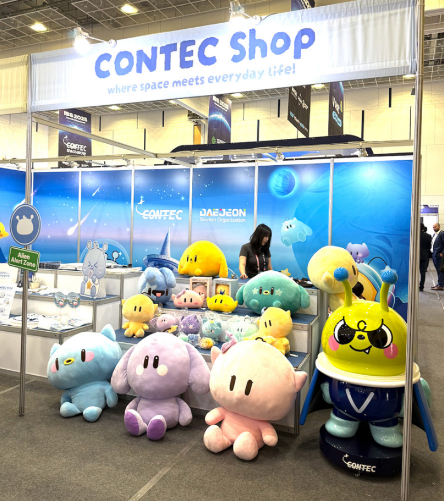
Finally, ISS 2025 was a showcase of Korean soft power and contemporary culture writ large. Nowhere was this more evident than the CONTEC Shop, which showcased the company’s efforts to popularize space with the masses as the place “where space meets everyday life!”.
Staffed by friendly and outgoing students, the shop seemed to be doing a brisk business throughout the show, as attendees bought space swag at reasonable prices for loved ones back home, and according to the official website, profits from CONTEC Shop are donated to social responsibility efforts.
The South Korean Space Sector Moving Forward
South Korea is an export powerhouse with strong S&T chops, and has punched above its weight in industries ranging from semiconductors to electric cars for some time. We should expect similar outcomes from space, bolstered by government support, international ties, and a unique combination of technical excellence and soft power marketing savvy. In short, a very intriguing blend of East and West.
----------------------------
 Blaine Curcio is the Founder of Orbital Gateway Consulting. He’s an expert on the global commercial space and satellite industries He can be reached at: blaine@orbitalgatewayconsulting.com