

by Bruce Elbert
Pan American World Airways, or PanAm, pioneered global air travel, summing it up with their slogan, “You Can’t Beat the Experience.” This is a double entendre that points to their special skills.
PanAm was deeply established around the world as the most experienced international airline, the model for all the rest. And, their flights were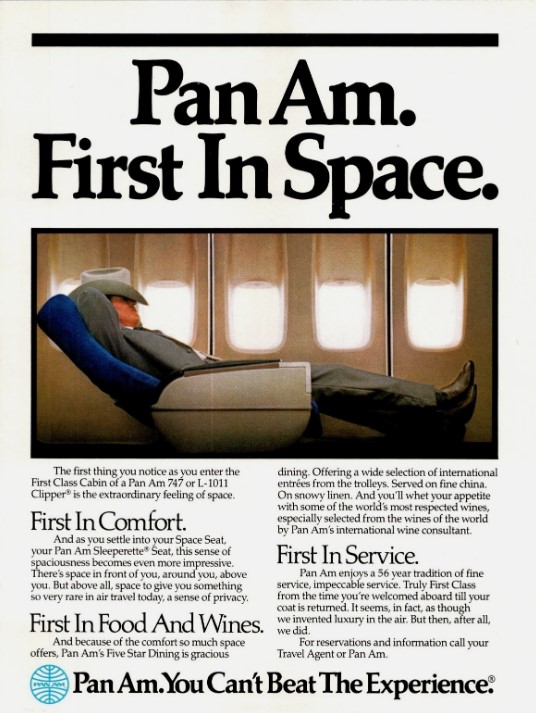 usually blessed with highly qualified cockpit and cabin crew who literally had been everywhere. On my first trip to Hong Kong in 1974, their purser suggested that I have breakfast at the Peninsula Hotel in Kowloon. That was a wonderful dining experience that I will never forget.
Satellite communications has some similarities to airline operations. Of course, satellites travel in space and so they too must be kept separate and under control from an organization or organizations. If you take all the world’s primary airlines you have a collection that is remarkably like what we have in our industry. In the end, we want to know that whoever is providing us with a flight has the experience and objectivity to do the job the best they can. This is like the satellite operator or network provider – do this right and have a loyal customer base.
But, business models are changing from confident profitability to something unpredictable. We only have to look at PanAm itself to see how uncompromising the business world can be. After consolidation and the selling off of routes to United and Delta Airlines, the last of their flights were shuttles between New York and Washington, D.C., hardly impressive for the former behemoth of global air travel. This is analogous to what is happening to Intelsat, the first global Geostationary satellite operator that will merge into its main competitor, SES. Inmarsat already joined Viasat, which itself only became a satellite operator in the last 15 years.
Experience then is valuable up to a certain point, but that point can surprise anyone who ignores what it means to have it. According to Google AI, experience is “practical knowledge, skill or ability gained through direct observation or participation”. I couldn’t have said it better myself.
Consider the oldest organization that is truly American: the US Army, which celebrates 250 years in 2025. I have some Army experience myself, having served in the Signal Corps from 1965 to 1969 in my field of radio communications. We lacked any SatCom back in the late 60s so all of my equipment was on the ground where we could install and operate it ourselves. Still, we always got the job done in the difficult terrain of Vietnam’s Central Highlands. Someone once said you need to know the secret handshake, or equivalently, to pay your dues. The expression I prefer is to have been there. School and research get you just so far but organizations need key staff with the experience on the job where it really matters. It’s like an expert system that has instant recognition of issues and their solution. The interface to this expert system is not from Google or ChatGPT. You can’t yell at your computer if it gives you a false response because a computer takes no ownership of results – it’s still up to you to be the judge.
I suggested in a contribution to Satellite Markets that a future vision requires (1) seeing what’s there, and (2) what’s not. Who better to make the best satellite communications deal than someone who’s been there before? One sad story relates to a satellite communications project started by a major US operator that could have involved China as well as several other East Asian countries. It failed due to inexperienced leadership who couldn’t see what was right in front of them – a regional partner who offered to do a 50/50 joint venture! Having missed what was obvious to me, this innovative project met cancellation, but the program was eventually saved by a deep-pocketed group in the Middle East who saw opportunities in EMEA. Another example is in cutting-edge multi-beam DBS using digital technology. Only because the contractor could demonstrate relevant expertise and substantial technical performance did the buyer commit to construction. Useful knowledge of the underlying physics and trust in interaction overcame rather uninformed direction.
".... The World Wide Web in general and AI in particular put research in quantity at our disposal. It may be readable or interesting, but is it relevant?..."
Getting to a deal is tough because customers don’t know what they want – the familiar IKIWISI (I’ll know it when I see it). A design on paper cannot convince a skeptic, unless that customer wants to see their vision come to fruition. But paper has weaknesses best addressed with valid demonstrations and in the age of massive computer systems, simulations. I’ve talked in the past about the first generation of Iridium, built according to specifications that on the face were inconsistent with the objective of supporting a pocket-size handheld satphone that could make and receive calls in normal places with shadowing and even blockage from car frames and buildings. Instead, Iridium was known to work adequately for simple voice calls where the user is out in the open with a clear view of the sky. The phone itself was anything but pocket size and the voice quality did not meet standards set by the mobile phone industry. All of the simulations and tests verified that the design would fall short as a service to business travelers.
Motorola created Iridium from the ground up, including a technology platform that was enviable for its day (but still not what the intended market expected). Their engineering team was top tier, and they oversaw a massive space and ground program. Much of the gateway equipment was purchased from existing suppliers and integrated with the help of US and European organizations. Today, ground segment leaders like ST Engineering iDirect, Comtech, Gilat and Hughes have their challenges since Starlink is vertically integrated. There also are several experienced technology suppliers of antennas, microwave components and baseband processors that when combined with the leaders are still important for “open systems” like GEO broadband and mobile, OneWeb and perhaps LightSpeed.
Motorola also met Iridium’s L-band spectrum challenge with a high degree of support from the FCC at the World Radiocommunication Conferences in 1993 and 1995. But, Motorola was in and out of Iridium having spent more than US$ 4 billion with no significant return to investors; its reputation suffered as a result. Today, that sum would have amounted to something in the range of US$ 8 to US$ 12 billion, now seen as table stakes in the LEO broadband arena. What would you do with “just” one billion! You better know the landscape of your segment of interest, and you better know what ingredients you require. I wrote abut this of this regarding the questions, who, what, where, when and how. Hard as it is, thorough research of these questions and adequate consideration of several compelling alternatives will map the course. Stepping back, system architecture is the approach where your look broadly across the alternatives using heuristics (engineering estimates) from qualified experts in the relevant fields. Independent work by MBA researchers won’t get you very far since they are limited by their knowledge of the alternatives and their respective ingredients. But, they can help the experts compile and present the data for consideration.
The book, Dangerous Company - The Consulting Powerhouses and the Businesses They Save and Ruin, by James O'Shea and Charles Madigan, outlines how management consultants may not be reliable decision makers – precisely because they lack hands-on experience. One old hand said that newbies think that they will succeed because they are smarter and work harder. The World Wide Web in general and AI in particular put research in quantity at our disposal. It may be readable or interesting, but is it relevant? I use AI as a tool because it digs deep and remembers information that I might not. We must be the ultimate judge because only human intelligence can make that connection. In other words, you can’t beat the experience!
------------------------
 Bruce Elbert is the Founder and President of Application Technology Strategy LLC.(www.applicationstrategy.com) He is a satellite industry expert, communications engineer, project leader and consultant with over 50 years experience in communications and space-based systems in the public and private sectors. Areas of expertise include space segment design and operation in all orbit domains, systems architecture and engineering, ground segment systems engineering, development and operation, overall system performance improvement, and organizational development. He can be reached at: bruce@applicationstrategy.com