



At the opening of CeBit Fair in 2006 Viviane Reding Member of the European Commission (EC) responsible for Information Society and Media said: "Mobile TV seems set to become the next high growth consumer technology," She then went on to argue in favor of harmonized European wide spectrum in order to facilitate Mobile TV. Three years later on May 13, 2009 the EC announced the award of two S-Band satellite licenses. Thus opening the door for the winning operators - Solaris Mobile and Inmarsat - to provide broadcast mobile satellite TV and other services throughout Europe. Unfortunately the path leading from that door is beginning to look more like an obstacle course than an open road.
Both companies received 2 x 15MHz pan-European spectrum in the 2GHz band, located adjacent to the UMTS spectrum. This spectrum can be used for hybrid satellite - terrestrial services including television, radio, internet and emergency services delivered to mobile devices. Reusing the frequencies terrestrially eliminates many of the issues associated with satellite signals in urban areas and also allows for in-building penetration.
The first obstacle is that some of those frequencies have previously been allocated to ICO-P. For reasons too lengthy to explain here, although the first MEO satellite was launched in 2001, none of the remaining nine that would complete the constellation are in orbit.
The second obstacle is this is the first time that the EC has awarded frequencies. Licensing normally takes place on a national level with the ITU responsible for frequency coordination. Even though the frequencies have been awarded at a pan-European level Solaris Mobile and Inmarsat will still have to obtain national licenses and pay any associated fees required by the individual countries.
The challenges started long before the announcement. In October last year ICO Global began proceedings in the European Court of First Instance to annul the actual process by which the EC was awarding the licenses stating that the process was illegal. (However, without prejudice, presumably in case it lost it ICO Global also submitted an application to the EC).
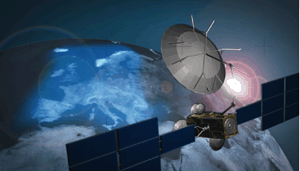
In February of this year Ofcom which is the UK representative to the ITU announced that following a 3 year review it was going to ask the ITU to cancel the ICO-P frequency assignments. Unsurprisingly ICO responded by applying to the High Court for a judicial review of the decision. This happened on May 22nd followed by Ofcom filing contesting ICO’s claim.
ICO is allegedly also claiming that no consideration was given to the fact that its involvement in legal proceedings against Boeing prevented it from submitting additional information by the required deadline. Therefore the EC’s decision is illegal.
Terrestar, the other failed applicant, has also initiated legal proceedings in the European Court of the First Instance seeking an annulment of the decision on the basis that its application was not read correctly initially, nor were the clarifications it submitted evaluated correctly.
Solaris If all of this wasn’t enough to contend with Solaris Mobile, which already had an S-Band payload in orbit and was therefore (unlike Inmarsat whose satellite was still in the design review stage) almost ready to begin service, found serious anomalies with the payload. It has been reported that it may be possible to start a limited service but alternative solutions in the form of other capacity or expediting the launch of the second satellite will be needed for full service.
Assuming that none of these obstacles turn into roadblocks is there a business for mobile satellite TV in Europe?
Mobile TV around the world is struggling to find a successful business model. With around 40 million viewers worldwide, i.e. just 1% of all mobile phone users it is still a nascent industry. Japan and South Korea with 18 and 17 million users respectively represent the largest markets. 90% of viewers in South Korea are using the advertising supported T-DMB service which currently reports an accumulated loss of over $100 million. In Japan the service is also free and running at a loss and a competing subscription service closed down due to lack of subscribers.
Although Europe at 117% has one of the highest penetration rates of mobile phones in the world, mobile TV has got off to a shaky start. Italy is the largest market with 1.2 million users (2% penetration). In Germany the license was handed back and at the time of writing the French broadcasters and operators still hadn’t reached agreement on the preferred business model meaning that the frequencies may soon be reallocated. As yet none of the trials in the UK have made it to a lasting commercial business. Meanwhile launches of streamed video, a unicast service (using 3G frequencies) continue; France for example has over 1million viewers using this technology.
Numerous reasons have been given for the slow start in Europe not the least of which is that this is a emerging industry and whilst there have been many trials there haven’t been many commercial launches. This is true but it is not the whole story. As with all new convergence businesses there are some key parameters that need resolution. These include:
Ø Technology – multiple standards exist worldwide making economies of scale at all points in the network harder to achieve. Europe has endorsed DVB-H, but this is now being challenged by a multi-national partnership formed in June promoting DMB as a standard.
Ø Business model – what is the optimum relationship between content providers, broadcasters, mobile operators, infrastructure providers and retailers?
Ø Revenue Stream: Viewers seem to prefer free – advertisers have a clear preference for a large audience, something which is not available in the early stages
Ø Digital Rights Management (DRM) and Conditional Access (CA) issues.
Ø Content: opinion differs as to whether viewers simply want what is available on a regular screen or short form specifically made for mobile content. Is the same content suitable for handsets as for seat back devices. With a limited number of channels this is a critical issue. (~9 from the satellite and an additional 18 from the repeaters, using Alcatel technology) None of these is going to be resolved overnight; it will likely take several false starts before a viable model emerges. However while all these issues are being hammered out viewing habits appear to be on the threshold of a major transition. The PVR is diminishing the importance of real time viewing for all but a few genres. Recent research from Nielsen showed that in the US time spent watching time-shifted TV increased by 40% from Q1 2008 to the same period this year. Streamed and downloaded video on the web coupled with Apps to deliver the same to mobile phones are driving a shift to instant gratification, i.e. video on demand, something that technically broadcast mobile TV cannot deliver. However with ever increasing storage on mobile devices theoretically operators would be able to push content to the device in off-peak periods thereby creating a limited amount of pseudo VOD. The key to success here will be identifying the right mixture of programming to satisfy diverse viewer needs. In years to come this may well pose the most significant threat to broadcast mobile TV.
There are currently five viable satellite consumer businesses: DTH, Mobile Telephony, fixed broadband, radio and satellite navigation (SatNav). In all of these except SatNav, satellite has been very much a follower. It took successful terrestrial services and extended their reach. (Although with WorldSpace in bankruptcy and a combined Sirius-XM still not profitable it’s questionable whether satellite radio can yet be considered a viable business). If this model holds true the market for mobile satellite TV in Europe is many years away and may well be overtaken by mobile Video (i.e. unicast not broadcast) which with the increased capacity offered by LTE will present less of a challenge to operators than it does today. Inmarsat has said very little about its business model other than it is looking for partners. As would be expected with a satellite already launched Solaris Mobile has been clearer. Wisely given the above, it has chosen to be the infrastructure provider, letting the operators and broadcasters sort out the optimal value chain. Perhaps even more wisely it is planning on using the frequencies not just for mobile TV but for value-added services including data-gathering, LBS and web-browsing; targeting pubic authorities, utilities and emergency services as well as well as consumers.
The other big question of course is "Is the market going to be large enough to support two operators?" It is early days and Europe is still in recession, but given the complexity of the emerging target markets, it will take some nimble footwork by both operators to stay in the game.
------------------------------------
Elisabeth Tweedie has over 20 years experience at the cutting edge of new communication and entertainment technologies. She can be reached at: etweedie@definitivedirection.com or phone at +1 310-292-0755 or +44 (0)7768 610574.