


by Kevin Dunne
Herefordshire, UK, March 12,2026--The satellite ground segment is undergoing a structural transition rather than a simple technology upgrade.
As bandwidth demands increase and ground architectures become more varied, operators are being asked to support multiple missions and orbits from shared infrastructure.
In high-density and multi-mission environments, long-established analogue intermediate frequency (IF) chains are increasingly approaching their practical limits. Digitization is widely accepted as the long-term direction of travel, but the pace and maturity of adoption across the industry remain uneven.
Within this context, the Digital IF Interoperability (DIFI) standard has become a focal point for discussions around openness, flexibility and interoperability in digital RF systems. DIFI is sometimes presented either as a decisive break from vendor-locked architectures or as a shortcut to plug-and-play integration. In practice, it is best understood as an enabling framework whose impact depends less on the specification itself and more on how carefully it is applied.
The ground segment’s digital transition: where are we really?
The pressures driving digital RF adoption are well understood. Higher channel counts, wider bandwidths and the need to support GEO, MEO and LEO systems from shared ground infrastructure place increasing strain on analogue RF distribution. As systems scale, analogue architectures become physically complex, harder to adapt in operation and costly to extend.
Digitized IF offers clear advantages. Converting signals earlier in the chain enables greater flexibility in transport and processing, supports the use of commercial networking technologies and allows for more modular system design. In theory, this should make ground segments easier to scale and adapt. In reality, progress has been uneven.
Many operational ground systems today are hybrid, combining analogue and digital elements. In some cases, digital interfaces have been added in isolation, delivering incremental benefits while leaving many underlying system limitations unchanged. In others, proprietary digital implementations have replaced analogue dependencies with new forms of lock-in. This mixed landscape is essential context when assessing what standards such as DIFI can realistically achieve.
Why standards alone do not guarantee progress
The existence of an open standard is often taken as a sign of maturity. Experience across multiple technology cycles suggests this assumption is misplaced. Standards define interfaces, not outcomes. They enable interoperability, but they do not remove the need for informed system design, careful integration work, or teams that are genuinely prepared to operate and support what is deployed.
In performance-sensitive environments such as digital RF, this distinction matters. Timing, synchronization and transport behavior all influence how systems perform in practice. A standard can align expectations at the interface level, but it cannot compensate for weak architectural decisions or unrealistic assumptions about how much work is required to make systems behave as intended. When standards are treated as a shortcut to simplicity rather than a foundation for disciplined design, the risk of disappointment increases rather than decreases.
What DIFI genuinely enables and what it does not
DIFI was developed to address a specific gap in the digital RF ecosystem: the absence of open, vendor-agnostic interfaces for digitized IF. By defining common data structures and behaviors, it enables different parts of the RF chain, from front ends through to transport and processing, to work together across suppliers.
Properly applied, this reduces dependence on vertically integrated RF chains and supports a more modular, multi-vendor ecosystem. It creates the conditions for innovation to occur at different points in the signal chain without requiring wholesale system replacement.
What DIFI does not deliver is automatic interchangeability. Interoperable components can work together, but they are not inherently equivalent. Performance characteristics, timing requirements and implementation choices still matter. Treating DIFI as a universal compatibility layer risks obscuring these realities and underestimating the importance of clarity over who is responsible when performance degrades or integration issues emerge.
The education gap holding back adoption
One of the most persistent barriers to progress is not technical capability but understanding. Many organizations recognize the strategic importance of digital RF, yet lack the internal expertise to specify, procure and integrate systems effectively.
This is particularly visible in procurement. Requests for “DIFI-compliant” solutions are increasingly common, but are often poorly defined. Without a clear understanding of the information being exchanged, performance requirements and responsibility for how the system behaves from input to output, compliance becomes a checkbox rather than something that genuinely improves operation.
In such cases, standards adoption can increase the risk and effort involved in making systems work together rather than reducing it. Expectations diverge, system behavior is misunderstood, and when performance degrades it is often unclear where responsibility sits. Education, both within operator organizations and across the supplier ecosystem, is therefore as critical as the specification itself.
Hybrid architectures as rational risk management
Hybrid analogue-digital architectures are often described as a transitional compromise. What has become clear, however, is that they are frequently the most rational response to financial, operational and capability risk.
Legacy analogue infrastructure represents significant sunk investment and continues to perform reliably within defined roles. Full end-to-end digitization can introduce cost, complexity and integration risk that is difficult to justify across all missions at once. Hybrid approaches allow operators to target digitization where it delivers the greatest value, while preserving proven analogue elements where appropriate.
This incremental strategy reduces exposure. It allows organizations to build digital expertise gradually, test new architectures in live environments and adapt operational processes without forcing disruptive, large-scale change. For many operators, particularly those supporting diverse missions, hybrid architectures are not a stopgap but a deliberate long-term strategy.
Adoption maturity and what to watch next
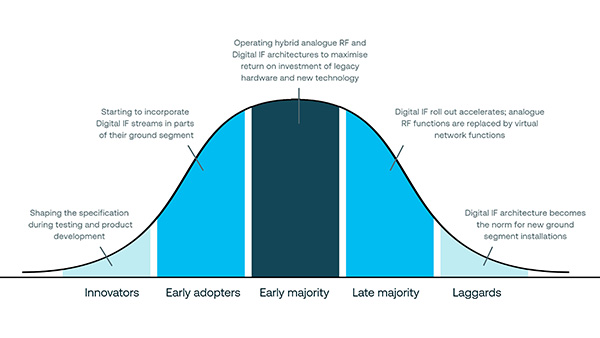
Looking at how the market is developing, DIFI adoption remains at an early stage. A small number of organizations are experimenting with open digital RF architectures in controlled environments, often supported by strong internal engineering capability and clear architectural intent.
For the broader market, progress is likely to be gradual. Skills development, organizational alignment and integration experience will shape timelines as much as specification maturity. Hybrid architectures are likely to dominate in the near to medium term, with full end-to-end digitization emerging selectively where operational and commercial conditions support it.
The future impact of DIFI will depend less on incremental changes to the specification and more on how the industry applies it in practice. Reference architectures, shared learning from interoperability testing and clearer guidance on responsibility for overall system performance will all be important.
DIFI provides a foundation, but it is experience, education and thoughtful implementation that will determine whether that foundation supports genuinely flexible, resilient ground segment infrastructure.
-------------------------------------------

Kevin Dunne is the CEO of ETL Systems. With over 20 years of experience in RF Systems for Satellite and Defense communications, he joined ETL in 2023 to lead transformative change. Kevin's vision has led the company through its pioneering Digital IF development program, bridging the gap between traditional RF technology and the evolving cloud-virtualized ground segment. He can be reached at: marketing@etlsystems.com