

by Jason Bates
Non-GEO constellation players have transformed the satellite communication (satcom) industry in the past five years. Leading this transformation is Starlink, which has set new benchmarks in satellite deployment speed, capacity influx, and customer acquisition. Other players like Amazon’s Kuiper, Eutelsat’s OneWeb, Telesat’s Lightspeed and SES’s mPower continue to reinforce the viability and advantages of Non-GEO solutions. As nations increasingly recognize the benefits, such as scalable bandwidth and reduced cost per Mbps, there is a growing shift toward developing sovereign constellations. These national initiatives are driven by the urgent need for secure communications, digital autonomy, and strategic resilience in response to shifting geopolitical landscapes and rapid technological progress.
The Starlink Impact
|
|
The unprecedented growth of Starlink has fundamentally reshaped the satellite communications landscape. In just five years, the company has launched over 10,000 satellites, adding approximately 500 Tbps of satellite capacity in orbit. Alongside its rapid deployment pace, Starlink has progressively upgraded its satellites from versions V0.9 to V1, V1.5, and V2 Mini, with each iteration enhancing per-satellite throughput. In its upcoming version, the company aims to achieve a throughput of 1 Tbps per satellite.
Chinese government-backed Guowang constellation aims to expand China’s digital footprint and influence, particularly in the Belt and Road Initiative partner countries. Considering these advancements, nations face growing concerns over foreign player service suspension, data interception, and traffic prioritization, especially during geopolitical tensions. Another concern is the orbital slot race, where spectrum congestion and orbital crowding may restrict access for late entrants. These advancements and associated concerns have led nations to increasingly prioritize the development of sovereign satellite constellations.
Indicators Signalling the Global Rise of Sovereign Constellations
A major indicator of the global momentum toward sovereign satellite constellations is the European Union’s IRIS2 program. This initiative reflects Europe's strategic intent to reduce reliance on non-European satellite connectivity networks, by deploying a multi-orbit constellation of 290 satellites by 2030. The program is led by the SpaceRISE consortium with incumbent satellite operators, SES, Eutelsat, and Hispasat. The consortium has extensive network of partners including Airbus Defence and Space, Deutsche Telekom, OHB, Orange, OHB, Hisdesat, Telespazio, Thales Alenia Space, and Thales SIX. The focus will be to provide secure communication to EU member states, covering government, enterprise, mobility and broadband applications.
India is actively evaluating the development of a sovereign LEO satellite constellation to address the country’s broadband connectivity needs. Various government departments are assessing both civil and strategic requirements to determine the viability of this initiative. The current consideration involves deploying ~140 satellites to meet immediate bandwidth demands, with a strong focus on supporting government services and enabling digital inclusion across underserved regions. Notably, India has already granted permission to foreign operators such as Starlink and OneWeb to offer satellite broadband services within its borders. This move underscores the urgency of establishing a sovereign alternative to ensure long-term digital autonomy, secure communications infrastructure, and strategic resilience in an increasingly contested orbital environment.
Australia has announced a consortium led by Optus to develop LEO satellites within the country. The initial developmental satellite will carry both earth observation and connectivity payloads. The broader vision is to build national LEO capabilities and potentially scale the technology into a sovereign satellite constellation.
Other countries likely to pursue sovereign satellite constellations in the coming years include the UAE with Space42, and Saudi Arabia. Both nations are aiming to secure national digital sovereignty and accelerate the development of their domestic space ecosystems. Their strategies are expected to range from building indigenous satellite constellations to forming strategic collaborations with global players.
The Future of Sovereign Constellations
The race for control over sovereign satellite constellation infrastructure is intensifying, driving increased investments from governments and national agencies that will significantly benefit the broader space industry ecosystem. While the strategic rationale for sovereign constellations is compelling, decision-makers must carefully evaluate the economic sustainability of such initiatives.
Non-GEO satellite constellations are inherently capital-intensive, with shorter satellite lifecycles and rapid technology turnover. Designed for global coverage, these systems face fundamental inefficiencies when restricted to serving a single nation, leading to underutilised capacity and potentially unsustainable operations. To mitigate this, nations must develop robust strategies to commercialise capacity on a global scale and account for existing and emerging competition. Ultimately, true and sustainable sovereignty in the Non-GEO connectivity domain will depend on achieving a balanced approach, one that harmonises autonomy with strategic partnerships, secure networks with commercial openness, and national investment with cooperative efficiency.
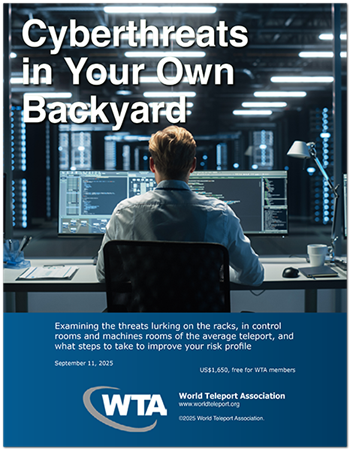
In the age of intense competition from emergent low Earth orbit operators and declining broadcast business, teleport operators are facing unprecedented business challenges, which they are addressing in part by embracing technologies that enable greater efficiency, easy scalability and closer integration with the mainstream telecommunications grid.
In doing so, however, these operators are increasing their exposure to threats of a different type: hackers seeking to penetrate networks for reasons including theft, government and corporate espionage, and extortion.
Traditional geostationary satellite and teleport operators have long touted security as a feature of their relatively closed-loop networks, but the emerging reality is they are becoming just as vulnerable as ground-based networks. Gone are the days when satellite telecom was a siloed universe, relatively insulated from now pervasive cyberthreats. And with a client list that includes government agencies and large corporations with sensitive information that must be protected, teleport operators recognize cybersecurity as an imperative.
Building a Cybersecurity Fortress
Cybersecurity is foremost in the minds of today’s teleport operators, who are taking a multi-layered, standards-driven approach to safeguard their networks and infrastructure from a growing array of digital threats.
Best practices begin early. Security is built into the design of ground systems, following internationally recognized frameworks and standards from organizations like the U.S. National Institute of Standards and Technology, the International Organization for Standardization and others.
On the ground, companies are deploying familiar tools: firewalls, signal encryption, access controls, intrusion detection and prevention systems and real-time threat monitoring systems. Access to critical systems is tightly managed through multi-factor authentication and role-based privileges. Routine vulnerability scans and round-the-clock traffic monitoring provide ongoing threat awareness.
The cloud, which today is increasingly integrated with teleport operations, is heavily guarded. Operators using platforms like Microsoft 365 and Azure are layering in identity verification and data loss prevention tools, backed up by regular security audits.
Monitoring centers work 24/7 to detect anomalies, respond to incidents and flag vulnerabilities before they’re exploited. Some operators run dedicated Vulnerability Operations Centers in parallel with their Security Operations Centers to stay ahead of emerging threats.
As is the case in other sectors, one of the biggest vulnerabilities for teleport operators comes from within; not from deliberate insider attacks but employees who inadvertently compromise networks by using unvetted devices or falling for social engineering ploys. That’s why satellite and ground network service providers are pouring resources into mandatory training for all employes on a regular basis, with specialized training for security personnel.
Cybersecurity is a Shared Responsibility
Protecting data and operations necessitates close collaboration between operators and customers. Because their operations are intertwined, an attack on one has implications for the other; some teleport operators, in fact, view customers as their first line of defense. The more sophisticated clients, such as internet service providers, tend to have robust protections, whereas those with fewer resources, or government and enterprise clients with unforgiving security requirements, generally ask more of the operators. In these cases, operators often rely on highly secure cloud networks like Amazon Web Services (AWS) or Microsoft Azure.
Automation technology, notably including artificial intelligence (AI) and machine learning, is fueling an arms race between teleport operators and cybercriminals. On one hand, these emerging technologies are enabling a new class of threats, including AI-generated phishing campaigns, adaptive malware and automated vulnerability scans—tools that evolve faster than conventional defenses can react. On the other hand, companies are increasingly turning to AI-powered platforms to detect behavioral anomalies, correlate threat intelligence and automate responses in real time. These systems help identify patterns that humans might overlook, allowing for more precise and proactive threat mitigation.
Future Trends
Satellite teleport operators are facing a threat landscape that is growing more sophisticated by the day. As cyberattacks increase in volume and complexity, companies are moving beyond traditional firewalls and antivirus software toward more adaptive, intelligent and layered defenses.
The rise of AI-driven threats—ranging from social engineering to autonomous malware—underscores the need for adaptive defenses. Zero-trust principles are gaining traction, and quantum-safe encryption is starting to appear on the radar. Companies understand they need not just continuous protection but an evolving strategy to stay ahead of the threat.
Zero-trust architecture is now the baseline—no device or user is trusted by default, even if they sit inside the network perimeter. This model is particularly critical as operators adopt hybrid and cloud infrastructure, which is harder to secure and manage without automation. AI and machine learning have become indispensable on both sides of the cybersecurity divide. Operators are deploying AI to detect anomalies, automate responses and strengthen SOCs. At the same time, attackers are leveraging AI to scale and customize their campaigns, making defense a moving target.
Across the board, teleport operators recognize that cybersecurity it a continuous, evolving mission, with no silver bullet solution. Participation in national cybersecurity frameworks, real-time threat intelligence sharing and collaboration with government agencies remain vital. So does the adoption of the latest technologies to, at minimum, keep up with nefarious actors—national, extranational or just plain criminal—whose attacks are becoming increasingly bold and sophisticated.
In summary, teleport operators aren’t just securing infrastructure—they’re reshaping their cybersecurity posture across all network layers to match the scale, complexity and persistence of the threats they face.
----------------------
 Jason Bates is editor for the World Teleport Association, which conducts research into the teleport and satellite industry, provides a unified voice for teleport operators and offers Teleport Certification programs to service providers. "From Teleport to Network Service Provider: The Search for Tomorrow’s Business Model" is available for free to members and for sale to non-members from WTA’s online store.