



Capt. Cherondra V. Spann, Project Manager of the USAF's Space and Missile Center was recently honored with the SSPI's Future Leaders award. The SSPI's Director of Development, Lou Zacharilla spoke with Capt. Spann on the critical mission of her team and various issues.
If having a the title Project Manager, SBIRS GEO-1 Space Vehicle, Space and Missile Systems Center, United States Air Force on your business card doesn’t qualify you as an adult, we need a new classification.
On Tuesday October 12 the satellite industry, through SSPI’s “Future Leaders” awards program, acknowledged the owner of the above title, Captain Cheronda V. Spann as one of its rising stars under 35 years of age. Despite a title long enough to roll across time zones Captain Spann is firmly grounded in the here and now, which defines an adult. I will not reveal her age, but say that during that annual event in Manhattan’s Princeton Club, known for heckling and heartfelt celebrations, Cheronda and two young colleagues, Intelsat’s Angela Wheeler and RRSat’s Shlomi Izkovitz, were clearly the only adults in the room!
The future is in good hands. “Youth is wasted on the young,” Oscar Wilde reportedly said. It was not the first time that the over-quoted Wilde had it precisely wrong. In the case of Captain Spann, ranked first in her category by the United States Air Force, not a minute is wasted, much less formative years. She is responsible for the assembly, integration and testing of the GEO-1 (URL) satellite system. GEO-1 is a complex and critical space surveillance effort. Its importance cannot be overstated. When most of us were her age, we read about projects like GEO-1 in Popular Science magazine. Or we gained our knowledge about such systems watching Captain James Kirk order his starship’s force fields to activate.
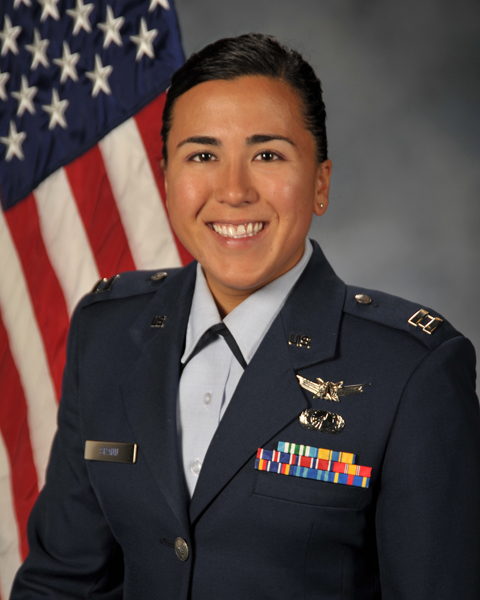 But this Spann kid, who Lt. Col. Jack Allen, Commander of the SBIRS Space Squadron says “epitomizes the values of integrity, excellence and service,” runs a science fiction program without the fiction. Her government paycheck is tied to a mission that is straightforward and sobering: to improve her country’s ability to detect ballistic missiles. Using diplomatic savvy that she may have learned in California hanging around with both Dodgers and Giants fans, she has “skillfully” interfaced government and commercial teams. In other words, she has the apples playing nice with the oranges. She has boosted the all critical software productivity component of the system by 300%. Productivity is important here, since the cost of Capt. Spann’s project (US taxpayers go for your Tums) is a whooping US $3 Billion.
But the mark of a true leader, past, present or future is always the degree of success balanced by humanity. Last Christmas, when most of us were home resting from our work, she led 20 members of her unit in support of a Los Angeles Food Bank. She raises funds for AIDS and is a regular on the ward floors of the local Veterans Administration Hospital. And if that guy sitting next to her at the dinner in New York (who was sticking to her like Scotch tape) is not her boyfriend or significant other, I have an email address for any of you who might want to thank her for her service and buy her a coffee.
Dianne VanBeber, Intelsat’s Vice President of Investor Relations & Communications introduced her to the audience in New York. She said, “Captain Spann represents the type of talent we need to remain in our industry. She is inquisitive and always looking for the best way to accomplish a task. She stays focused on the mission until it is done. I hope she likes satellites enough to stay around them for awhile!”
Me too. I gush at the thought of someone with so much potential, who seems too good to be true. Will she and her two fellow future leaders “stay around” in the satellite industry? I thought I would find at least talk to her about it.
Lou Zacharilla (LZ): You were recently given SSPI's Future Leaders award. Which means a committee of your elders thinks that you have what it takes to lead. What in your view are the primary requirements of a leader: past, present or future?
Capt. Spann: I believe there are three requirements. One is taking care of your people. The second is understanding the mission, and the third is knowing how to balance compassion and a stern demeanor, while understanding the context of a situation.
LZ: I agree, especially with the second requirement. I believe one of the primary reasons for mission failure, as well as personal failure, is an inability to remember what the mission really is. You forget the mission and you lose your focus. It’s a formula. I think you would agree that it is also is up to leaders to remind you. So who are leaders or mentors that have helped you stay on mission in life?
Capt. Spann: They are Lt. General John Sheridan, Major General Susan Mashiko, and Lt. Colonel Heath Collins.
LZ: That’s interesting. Three people in the Air Force. Why?
Capt. Spann: I admire them for their hard work, dedication to mission and how they understand the needs of their people. They embody the Air Force's core values and they are easy to talk to. They let you know when you are doing something less than desired and they aim to point you in the right direction. They do so without telling you exactly what to do. They really are inspirational for me.
LZ: Gee, that doesn’t sound like the bossing around I remember from the Army. It actually sounds like a breeding ground for innovation. But then, the Air Force needs to be innovative. Do you believe it is a requirement in your project management work with GEO-1? Or are you just there to take orders?
Capt. Spann: Well, sir, I am here to take orders. But yes. Innovation is important, because if something doesn't go according to plan, you need to try something else.
LZ: You need to be adaptive.
Capt. Spann: In my work the need is always there to adjust, and there is a constant pressure to provide for the war fighter. That is Job One. Therefore, if the plan doesn't work as is, it is time to gather the team and develop a better plan. As the saying goes "There is more than one way to skin a cat.".
LZ: The most rigid things break. Colonel William Harding, the Vice Commander of the Military Communications System Wing (Space & Missile Systems Center) said that the major challenge of the work is to ensure the synchronization of the space segment with the ground segment, including terminals and missile control elements. Where do you fall within that chain of command and mission task?
Capt. Spann: My team and I are in charge of ensuring we have the space vehicle ready. Colonel Harding is right. The ground segment is an essential part of the mission. Both are needed to succeed. In our program we do our best to ensure that both space and ground segments are in sync.
LZ: I don’t think people fully appreciate the degree of difficulty of your work. The same is true for our industry overall. We make it look increasingly easy and seamless. That is the intention on the commercial side. We know that it is not like turning on a light switch, but the complexity needs to be minimized. Or at least it cannot look too complex to the customer. You are of course a “future” leader. So look into the future and tell me what the satellite industry will look like when you are my age.
Capt. Spann: I think the satellite industry will continue to grow, but I really think it will remain complex. As technology continues to evolve, so will our space systems. My hope is that we will be able to produce advance systems faster. The mission depends on it for the Air Force.
LZ: With a $46 billion dollar portfolio for military satellite communications, $3 billion of it committed to your GEO-1 project, we will be watching to see how it evolves. Good luck, Captain. Thank you for your service and congratulations once again.
-----------------------------

Lou Zacharilla is the Director of Development of the Society of Satellite Professionals International (SSPI). He can be reached at: lzacharilla@sspi.org