



Global Markets - Market Trends
 The World Teleport Association (WTA) today released High Performance: Safety & Security, a new research report that shares insights about the most common under-appreciated safety and security issues at teleports and how their management can best address them.
The Over-the-Top (OTT) video market will surpass US$200 billion by 2024, with 90% of that value fueled by subscription and advertising revenue, according to a new report by global tech market advisory firm, ABI Research.
Addison, Tex., January 27, 2020--New research from Parks Associates finds that TV sets still dominate home entertainment, accounting for over one-half of all video consumed by US broadband households each week. 360 View: Digital Media and Connected Consumers reveals consumers report spending on average nearly 20 hours per week watching video on a TV, compared to nearly four hours on a mobile phone.
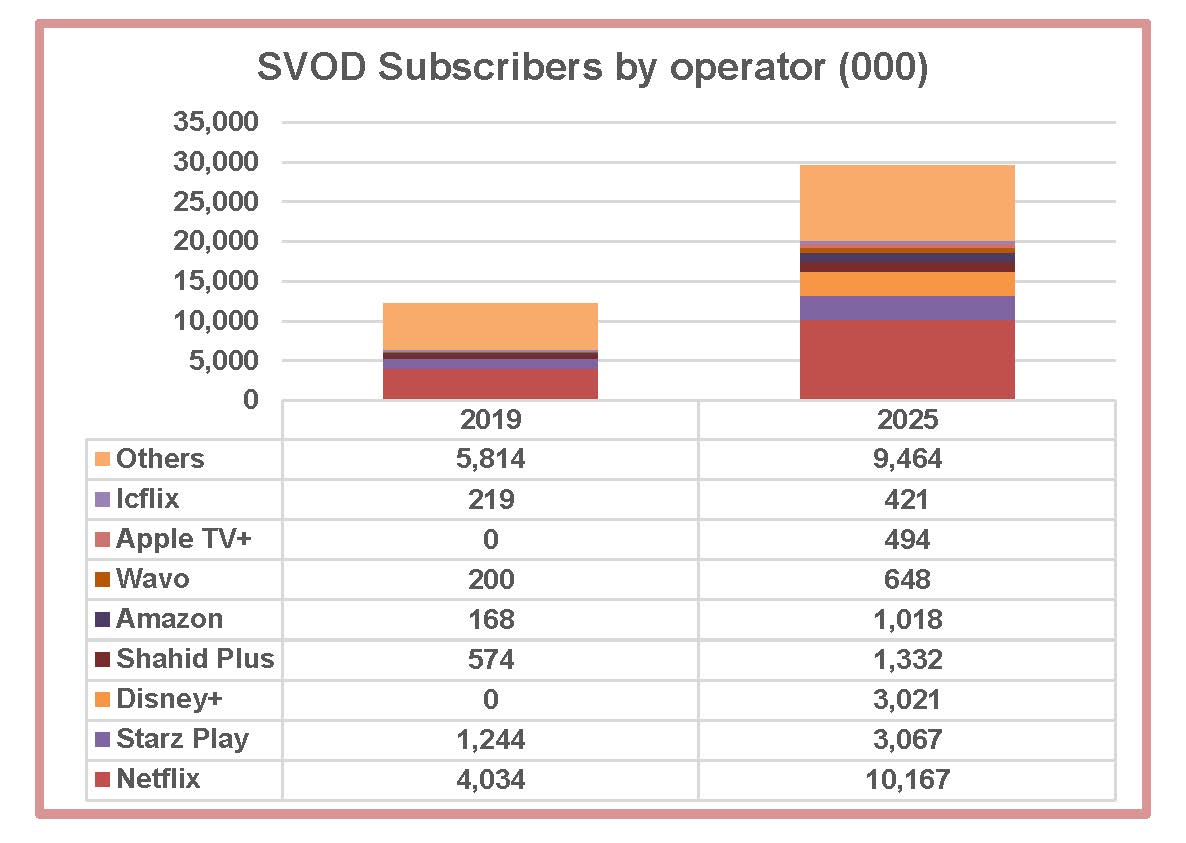 MENA Subscription Video on Demand (SVOD) revenues will reach US$2.97 billion by 2025; or US$ 2.1 billion more than the 2019 total according to new research from Digital TV Research. SVOD revenues will triple between 2019 and 2025. Turkey will total to US$ 908 million by 2025, with Saudi Arabia adding US$ 563 million and Israel US$ 470 million.
Pay TV revenues for the 20 countries in the Middle East and North Africa region fell by 12% between 2016 and 2019 to just under US$ 3 billion according to new resarch from Digital TV Research. Given the hangover from the beIN ban and generally falling ARPUs, revenues in 2025 (US$ 2.81 billion) will still be lower than in 2019.
Total Pay-TV industry revenue, comprised of subscription fees and local & regional advertising sales, grew 6% in Asia Pacific in 2019 reaching US$ 57 billion in 2019, according to Asia Pacific Pay-TV Distribution 2020, a new report published by leading industry analysts Media Partners Asia (MPA). Projections from MPA indicate that total pay-TV industry revenues will grow at a CAGR of 3% between 2019-24 to top US$66 billion by 2024.
The World Teleport Association (WTA) today published its annual rankings for the Top Teleport Operators of 2019. The annual rankings of companies by revenue and revenue growth are compiled by surveying teleport operators around the world as well as referencing the published results of publicly-held companies.
In its latest analysis of satellite manufacturing and launch services, Satellites to be Built and Launched by 2028, Euroconsult projects that the satellite market will experience a radical transformation in the quantity, value and mass of the satellites to be built and launched with a four-fold increase in the number of satellites at a yearly average of 990 satellites to be launched, compared to a yearly average of 230 satellites in the previous decade. The market will reach US$ 292 billion over the next decade.
A boom in virtualization of fixed broadband access infrastructure is developing and will sweep through almost all connections over the next decade, passing the 500 billion mark in 2025. That will be 40% of the total 1.26 billion global broadband subscriber base by then, compared with just 0.48% at the end of 2018 and 2.58% now at the start of 2020. These findings have just been reported by Rethink TV, the research arm of Rethink Technologies Research, in its latest report, Broadband Virtualization Accelerates to 500 million connections By 2025.
A major new report by Strategy Analytics, released to coincide with this week’s CES in Las Vegas, suggests that smart homes have now become the majority in the US. According to the survey of 2642 respondents in Q4 2019, 54% of homes own at least one smart home device, with the most popular being smart speakers, interactive security systems and smart thermostats. Smart home adopters say that the main reasons for buying into the smart home products are that they are easy to use, very convenient and that they feel more secure.