



Global Markets - Latest Developments
Globecomm reported fiscal 2012 second quarter revenues increasing by 35.5% to a record US$95.2 million as compared to US $70.2 million in the same period last year. Revenues from service increased 15.6% to a record $54.7 million, as compared to $47.3 million in the same period last year. The increase in service revenue was primarily driven by the company’s acquisition of ComSource, completed on April 2011, which contributed $6.4 million, coupled with an increase in scope on a major government program in the Middle East.
According to the results of the latest TV Monitor study, for the first time in the history of television in Germany, more viewers are watching TV via satellite than via cable. At the end of 2011, 17.5 million households were watching TV via satellite, almost 900,000 more than in the previous year. Ninety percent of these households were digital, leaving 1.8 million households still in the analogue reception mode. Out of the total, 5.9 million of all satellite households were watching High Definition (HD) TV.
A new study released by Telsyte confirms the rise of subscription TV over broadband with more than 300,000 Australian homes now accessing an IPTV service. This equates to around one in ten subscription TV services currently delivered over broadband.Telsyte forecasts that by 2015, over one third of all subscription TV services will be provided over broadband.
Euroconsult announced today that it expects prospects for the satellite industry to remain favorable over the decade in a variety of areas. The next ten years should see continued growth for commercial markets, while at the same time stagnating growth for government spending should be expected at least through mid-decade.
 CommunicAsia2012 and BroadcastAsia2012 will highlight pertinent industry developments and address emerging trends as well as provide enhanced networking opportunities for industry professionals from around the world. EnterpriseIT, held in conjunction with CommunicAsia, will showcase innovative applications and end-to-end solutions across the entire value chain and transform the way companies operate and communicate internally and beyond. And once again, the event will present Asia’s largest contingent of satellite companies witnessed at any single event.
This will be the year the consumer electronics (CE) industry finally realizes the promise of multi-screen content consumption. According to a new report by IMS Research, an independent supplier of market research and consultancy to the global electronics industry, shipments of residential data modems and gateways will reach 135 million in 2012, and shipments of IP-enabled consumer electronics devices will approach 2.5 billion, rising to 3.5 billion in 2015.
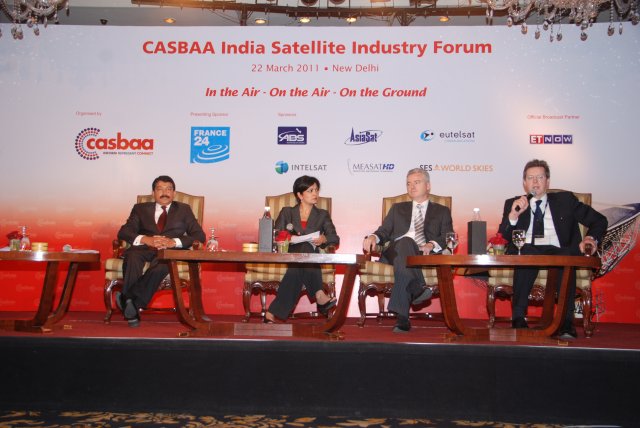 India boasts a US$7 billion multichannel TV market yet only 60% of the country's vast population owns a television. To addresses pertinent issues in the Indian satellite and broadcast market, the Cable and Satellite Broadcasting Association of Asia (CASBAA) is holding its annual India Forum at the Shangrila Hotel in New Delhi on March 20, 2012.
In January 2012, an agreement to buy shares in the U.S. Wideband Global Satcom (WGS) was signed by Canada, Denmark, Luxembourg, the Netherlands and New Zealand. The agreement enables immediate access to WGS capacity in exchange for financing the WGS-9 spacecraft. Moreover, a WGS-10 satellite is expected to be contracted soon.
Despite the ongoing impact of the Arab Spring protests and a dramatic re-ordering of political affairs still reverberating, the Middle East region remains a key growth area for commercial satellite industry.
This was the assessment of Gordon McMillan, Director of Government Services for global satellite network provider Inmarsat, who projected that the global government and military communications will rise to US$9 billion by 2018 with the Middle East becoming a key growth region for the commercial satellite industry because of the exponential demand for greater bandwidth.
by Martin Jarrold
London, February 1, 2012--Taking place on the second (29thFebruary) and third (1stMarch) days of CABSAT 2012, at the Dubai International Convention & Exhibition Center (DICEC), is GVF MENASAT @ CABSAT, which this year will comprise the Satellite Interference Mitigation Forum, and the Satellite Markets & Services Summit.