



Americas Markets - Market Trends
Los Angeles, Calif. , April 5, 2024

The market for Flat Panel Satellite Antennas (FPA) has been experiencing growing in the last five years and existing and companies are planning to compete for the multi-orbital antenna market. As we observed during the Satellite 2024 Exhibition and conference in Washington, D.C. held last month, we found more than 20 companies showing flat panel satellite antennas in the show floor for the major markets that include aeronautical, terrestrial and maritime & broadband for mobility/fix applications and focus in the end user market, enterprise and government and military.
Paris, Washington D.C., Montréal, Yokohama, Sydney, April 7, 2024

NovaSpace, formerly Euroconsult, leading space consulting and market intelligence firm, is forecasting that the worldwide launch rate for defense and dual-use satellites will jump by 160% over the coming decade.
Dublin, Ireland, April 4, 2024
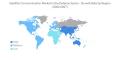
The Satellite Communication Market in the Defense is expected to grow from USD 5.55 billion in 2024 to USD 7.76 billion by 2029, at a CAGR of 6.93% during the forecast period (2024-2029).
Bristol, UK; April 3rd, 2024

In a cruel twist of irony, subscriptions are becoming ever-more essential to the survival of AVoD platforms. The stalwarts of internet video are set to bring in over $546 billion in revenue over the next five years, but the ad-supported business model which many of these platforms pioneered is clearly serving them no longer.
Dublin, Ireland. March 21, 2024
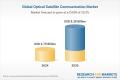
The Optical Satellite Communication Market size was estimated at USD 2.30 billion in 2023, USD 2.75 billion in 2024, and is expected to grow at a CAGR of 20.27% to reach USD 8.38 billion by 2030.
New York City, March 11, 2024

WTA has released its newest research report, SD-WAN for Competitive Advantage and Revenue Growth. The report is free for WTA Members and available for purchase by others. Click here to get the report.
Dublin, Ireland, March 4, 2024
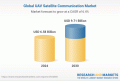
The UAV Satellite Communication Market size was estimated at US$ 6.29 billion in 2023, US$ 6.58 billion in 2024, and is expected to grow at a CAGR of 6.39% to reach US$ 9.71 billion by 2030 according to new research from Research and Markets.
London, UK, March 2, 2024
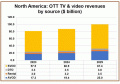
North American OTT TV episode and movie revenues will reach US$ 100 billion in 2029; up from US$ 81 billion in 2023. The US will contribute US$ 16 billion from the US$ 19 billion additional revenues, with Canada supplying the rest. US revenues will be $92 billion in 2029 according to Digital TV Research.
Dublin, Ireland, February 28, 2024

The Satellite Communication Market in the Defense is expected to grow from USD 5.55 billion in 2024 to USD 7.76 billion by 2029, at a CAGR of 6.93% during the forecast period (2024-2029) according to new research from Research and Markets..
London, February 26, 2024
The latest research from Ampere Analysis finds that total revenues from streaming (including advertising revenue from hybrid streaming subscription tiers) will overtake revenues from pay TV subscriptions in the US for the first time in Q3 2024. Streaming will continue to race ahead as traditional pay TV declines - with the value of pay TV in 2028 expected to fall to half the value it saw at its peak in 2017. The new analysis comes from Ampere’s continuously updated Markets Operators data service.