


Americas Markets - Latest Developments

The SATExpo Summit opened today as part of SATExpo 2026 at the Dubai Exhibition Centre, Expo City Dubai, bringing together satellite operators, technology providers, government stakeholders and investors to examine the technologies, business models and emerging opportunities shaping the future of the space economy.
WISeSat.Space Holdings Corp. (Nasdaq: SAIQ) , a space technology company focused on PQC secure satellite communications and Internet of Things connectivity, announced that it completed on that date its previously announced business combination with Columbus Acquisition Corp (CAC), a publicly traded special purpose acquisition company. The Business Combination was approved by CAC’s shareholders at an extraordinary general meeting held on September 30, 2026. Effective today, October 2, 2026, WISeSat.Space’s ordinary shares will begin trading on Nasdaq under the ticker symbol “SAIQ”.
Airbus Defence and Space has finalised the acquisition of the French cybersecurity company Quarkslab following regulatory approvals. This investment is another step in Airbus’ strategy to reinforce its position as a trusted, sovereign partner for French authorities, while expanding its footprint in the European cybersecurity landscape according to the company.
Redhill, UK, September 24, 2026--System integrator NSSLGlobal announced the acquisition of MetOcean Telematics (UK) Ltd. MetOcean Telematics ( provides global security, surveillance and IOT asset tracking solutions for international law enforcement as well as for enterprise customers and high profile individuals. In addition, the company is specialized in covert vehicle fitting, including surveillance and communication equipment.
AvL Technologies announced the acquisition of PathFinder Digital, a developer of advanced satellite communications technologies for defense, government and commercial customers.
IBC2026 brought the global media, entertainment and technology community together for four days of business, innovation and collaboration at the RAI Amsterdam. Welcoming 41,225 attendees from 170 countries and more than 1,300 exhibitors, the show reflected an industry focused on turning rapid technological and commercial change into practical progress.
Rocket Lab Corporation (Nasdaq: RKLB) today announced it has successfully completed several critical milestones to fully finance its pending acquisition of Iridium Communications Inc. Rocket Lab has completed its previously announced At-The-Market share sale (the “ATM Program”), raising approximately US$ 1.944 billion in gross proceeds through the issuance of 29.3 million shares (before commissions and offering expenses).
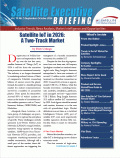
The September-October 2026 issue of the Satellite Executive Briefing magazine focusing on the Satellite Internet of Things (IoT) market featuring:
Satellite IoT in 2026: A Two-Track Market by Hub Urlings
Trends in the IoT Market for Satellites by Bernardo Schneiderman
How Satellite IoT Can Enhance Remote Water by Alastair Macleod
From Constellations to Convergence: Value Beyond Coverage by Markus Fritz
The Power of Data: Rethinking the Value of Satellite Broadcasting by Adir Hadad
Military vs. Civil Spending: The Defining Shift in Government Space Budgets by Aishwary Pachauri
Show Report: AI for Good Global Summit with an interview with will.i.am by Roxana Dunnette

by Markus Fritz
The satellite industry has proven it can deliver connectivity almost anywhere on Earth. Ubiquitous coverage is no longer a differentiator; it is the baseline. For the next generation of smart mobility autonomous vehicles, precision agriculture, connected rail, advanced air mobility and defense - true value lies in intelligently orchestrating multi-orbit assets and multi-domain space capabilities, seamlessly integrated with terrestrial networks. The era of convergence has begun, where Satcom, Positioning, Navigation and Timing (PNT), Earth Observation (EO) are fused into single, actionable streams.
by Alistair Macleod
How data is monitored is changing across the water sector. It is no longer something that is merely collected for compliance and reviewed periodically. It is being examined more closely, and more often, by a wider set of stakeholders. Regulators are asking more of it, the public is seeing more of it, and when incidents occur, it is often the first place scrutiny turns.